MCP server · Notes
Open Ontologies MCP server
by fabio-rovai
Let your AI check, query and safely change knowledge graphs, with a proof you can verify.
Open Ontologies is a helper for people who work with knowledge graphs: structured collections of facts, like a very organised set of spreadsheets about your business. It lets your AI load those facts, ask questions about them, and plan changes before anything goes live. It is handy if you maintain a shared vocabulary of terms and rules for a team or company.
What is an MCP server? The 30-second version
On its own, your AI can only chat. An MCP server is a small helper program that gives your AI a new skill or a connection to an app or service. This one connects your AI to Open Ontologies, a tool that stores and reasons over knowledge graphs. Once connected, you can ask your AI to load a file, run a check or plan a change, and it will do it through this helper for you.
What this MCP server does
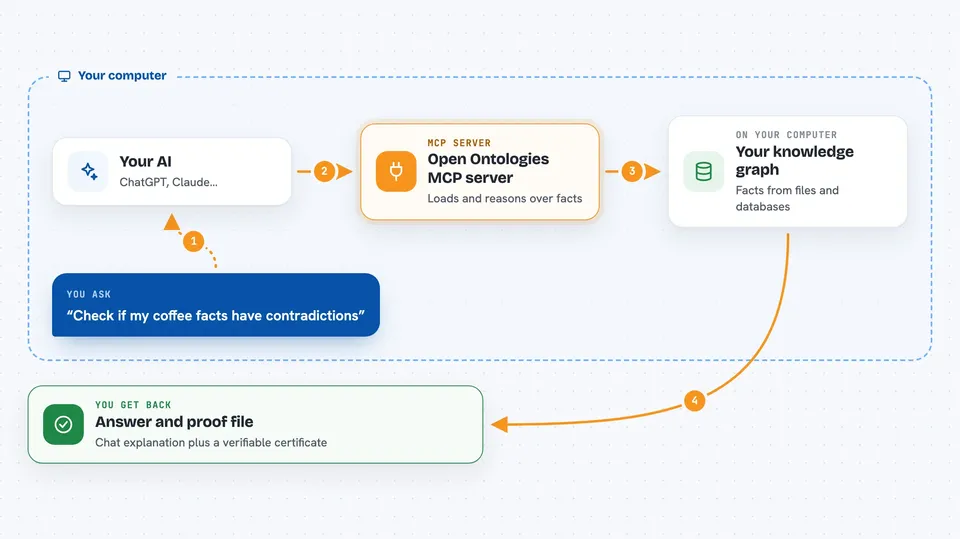
You ask your AI something in plain words, like whether a change to your vocabulary is safe. The AI passes that request to this helper. The helper loads your facts into its own store, reasons over them, and works out what follows from what. It can also compare a proposed change against the current version and tell you what would break. Then it hands the answer back, and your AI explains it to you in the chat.
 Click to zoom
What you can do with it
- Load facts from spreadsheets, CSV, JSON and databases into a knowledge graph
- Ask what follows from your facts, with a step-by-step proof
- Check a proposed change and see what it would affect before you apply it
- Validate your data against a set of rules and get a report
- Ask whether a definition is possible or contradicts itself
- Pull out a small, relevant slice of your facts for use in AI answers
- Roll back a change if something goes wrong
Try asking your AI
- “Load my coffee.ttl file and tell me what it implies”
- “Plan this change to my supplier vocabulary and show me the blast radius”
- “Check whether my ontology has any contradictions”
- “Give me a small slice of my knowledge graph about Northwind for a summary”
What it gives back to you
You get answers in the chat, like a list of new facts, a risk score, or a short report of problems found. For reasoning runs, it also writes a certificate file that a separate checker can verify later. If a change is planned, you see what would be added, removed or affected, and how risky it looks. You can ask for the certificate file and hand it to a reviewer.
Before you start
What you need
- The Open Ontologies program installed on your computer (it ships as one file)
- A knowledge graph file or data source to work with
- An AI app that supports MCP, like Claude Desktop or Cursor
Good to know
It can change or remove facts in your knowledge graph, so plan and review before you apply anything to a live setup.
Install it with your AI
Add Open Ontologies MCP server to your AI, no technical skills needed
You don't install anything by hand. You copy one prompt, paste it into an AI that can work on your computer, and it checks, installs and connects the server for you, asking you when it needs something.
Sign in to get the install prompt
Members get a ready-made prompt that lets the Claude desktop app check Open Ontologies MCP server, install it and connect it for them, step by step. You don't need any technical skills: you copy, paste and answer a few questions. Your connected AI can also find and install any of the 4,066 MCP servers here for you.
Who it's for
People who look after shared vocabularies, data models or knowledge graphs for a team, and anyone who needs to show that a change to those facts is safe.