MCP server · Developer tools
LintBase MCP server
by lintbase
Lets your AI read your real Firestore schema so it stops inventing field names and broken queries.
LintBase is a helper that looks at your live Firestore database and tells your AI what is actually inside it. It is handy for developers who use AI coding tools like Cursor, Claude Desktop, or Windsurf and keep getting code that references fields that do not exist. If your database has drifted away from your code, this is for you.
What is an MCP server? The 30-second version
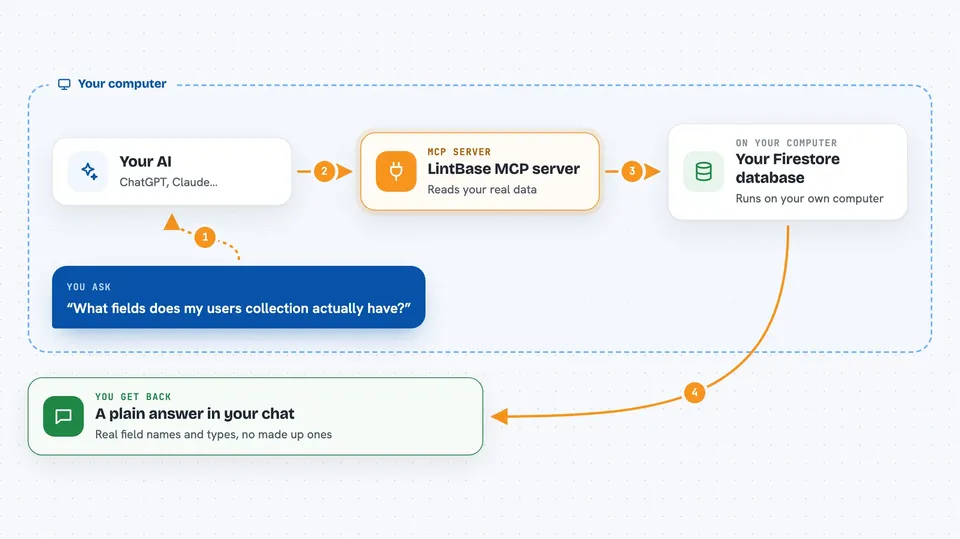
On its own, your AI can only chat with you. An MCP server is a small helper program that gives your AI a new skill or a connection to another service. This one connects your AI to LintBase, which reads your Firestore database. So when you ask your AI to write a query, it can first check your real collections and field names instead of guessing.
What this MCP server does
You ask your AI something like "add a field to users". The AI calls this LintBase helper. The helper looks at your live Firestore collections and reports the real field names, types, and how often each field appears. The AI then writes code based on what is actually there. You get a query or a change that matches your real data instead of a made-up one.
 Click to zoom
What you can do with it
- Check the real field names in a Firestore collection before writing code
- See what types a field actually has across your documents
- Spot fields that appear in most documents but are missing in some
- Find collections that are readable without authentication
- Notice fields that look like personal data, such as emails or phone numbers
- See which collections are large enough to cost real money to read
- Get a summary of your schema so your AI stops inventing fields
Try asking your AI
- “What fields does my users collection actually have?”
- “Add an isVerified field to the users collection and show me the code”
- “Which collections in my Firestore have no authentication check?”
- “Is the price field in products stored as a number or a string?”
What it gives back to you
It gives your AI a summary of your Firestore schema: collection names, real field names, types, and how often each field appears. It can also report issues like missing auth rules or fields with mixed types. Your AI then uses that to answer you or write code. You see the result as a normal reply in your chat, not as a raw file.
Before you start
What you need
- A Firebase project with Firestore data in it
- A Firebase service account key file (a JSON file you download from the Firebase console; it acts like a password for your project)
- Node.js installed on your computer
- An AI tool that supports MCP, such as Cursor, Claude Desktop, or Windsurf
Good to know
It reads your live database, so make sure the service account key stays private and never gets committed to git.
Install it with your AI
Add LintBase MCP server to your AI, no technical skills needed
You don't install anything by hand. You copy one prompt, paste it into an AI that can work on your computer, and it checks, installs and connects the server for you, asking you when it needs something.
Sign in to get the install prompt
Members get a ready-made prompt that lets the Claude desktop app check LintBase MCP server, install it and connect it for them, step by step. You don't need any technical skills: you copy, paste and answer a few questions. Your connected AI can also find and install any of the 4,609 MCP servers here for you.
Who it's for
Developers and small teams who use AI coding tools and work with Firestore or MongoDB databases.