MCP server · Research
Chinese History MCP server
by lizhuojunx86
Ask your AI about classical Chinese history and get answers with the exact book, chapter and paragraph cited.
This is a small helper program that lets your AI look things up in nine classical Chinese texts, from the Analects and Zuozhuan to the Shiji and Zizhi Tongjian. Every answer comes with a citation showing which book, chapter and paragraph it came from. It is handy if you read or write about early Chinese history and want to check where a story actually appears.
What is an MCP server? The 30-second version
On its own, your AI can only chat from what it already learned, and it can make things up. An MCP server is a small helper program you connect to your AI that gives it one new skill. This helper gives your AI a way to search a fixed set of classical Chinese books. When you ask a question, your AI sends it to this helper, the helper looks it up in its database of texts, and sends back passages with their sources.
What this MCP server does
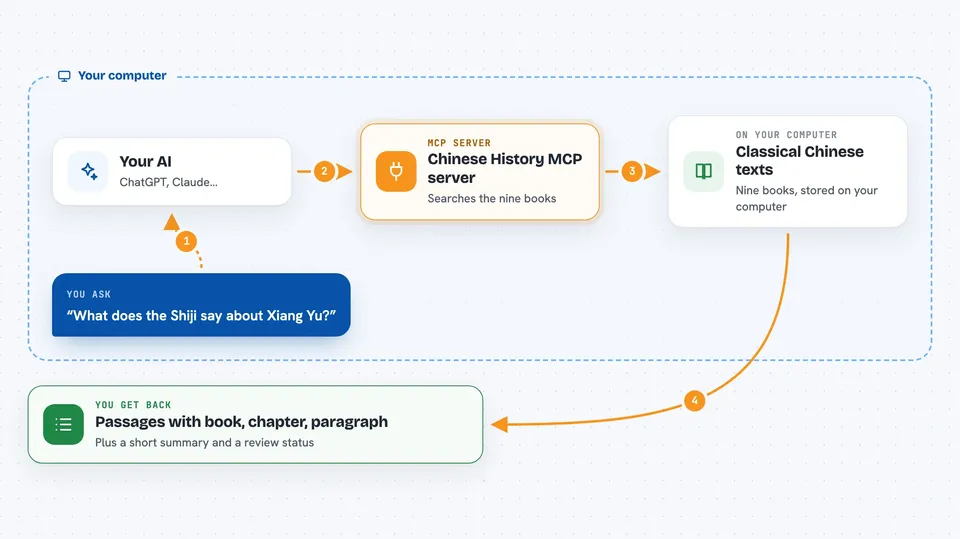
You ask your AI something about early Chinese history, like a person, a place, an event or a virtue. Your AI passes that question to this helper program running on your own computer. The helper searches its database of nine classical texts and finds matching passages. It sends back the passages along with a citation in the form book, chapter, paragraph, plus a short machine-written summary. Your AI then shows you that answer in the chat, and you can see exactly where each piece came from.
 Click to zoom
What you can do with it
- Search across all nine books for events tied to a keyword, a book, a person or a type of event
- Look up a person and see their profile, what others said about them, and their relations to other people
- Find ancient stories tied to a modern place name, with the option to pick between same-named places
- Search by a quality such as loyalty or strategy and get events, people and stories with a quote from the original text
- See the exact book, chapter and paragraph behind every result so you can check it yourself
- Read a short machine-written summary alongside the original passages
Try asking your AI
- “What does the Shiji say about Xiang Yu?”
- “Find events about the battle of Red Cliffs across all the books”
- “Which stories are set in what is now Nanjing?”
- “Show me examples of loyalty in the Analects and the Zuozhuan”
What it gives back to you
You get a list of matching items, each with a citation showing the book, chapter and paragraph it came from. For people you also get a short profile, quotes from others about them, and their relations to other people. For places and qualities you get stories and quotes from the original text. Each result also carries a status label telling you whether it was reviewed by a person or generated and checked by machines.
Before you start
What you need
- Python 3.9 or newer on your computer
- The corpus database file, about 90 MB, downloaded from the project's Releases page
- An MCP client such as the Claude desktop app, Cline or Continue
Good to know
The summaries, translations and status labels are machine-generated, so treat them as a starting point and check the cited original passage yourself before relying on them.
Install it with your AI
Add Chinese History MCP server to your AI, no technical skills needed
You don't install anything by hand. You copy one prompt, paste it into an AI that can work on your computer, and it checks, installs and connects the server for you, asking you when it needs something.
Sign in to get the install prompt
Members get a ready-made prompt that lets the Claude desktop app check Chinese History MCP server, install it and connect it for them, step by step. You don't need any technical skills: you copy, paste and answer a few questions. Your connected AI can also find and install any of the 4,609 MCP servers here for you.
Who it's for
People who read, study or write about early Chinese history, from students to teachers to curious readers.