MCP server · Developer tools
Kubernetes MCP server
by strowk
Lets your AI look at your Kubernetes clusters: pods, logs, events, and resources.
This is a small helper that connects your AI assistant to Kubernetes, the system many companies use to run their apps on servers. Once it is set up, you can ask your AI in plain English what is running, what is broken, and what the logs say. It is handy for anyone who works with a Kubernetes cluster but does not want to memorize commands.
What is an MCP server? The 30-second version
On its own, your AI can only chat with you. An MCP server is a small helper program that gives your AI a new skill or a connection to another system. This one connects your AI to Kubernetes, so it can look things up in your clusters and, if you allow it, make changes there. You just ask in normal words, and the helper does the technical part behind the scenes.
What this MCP server does
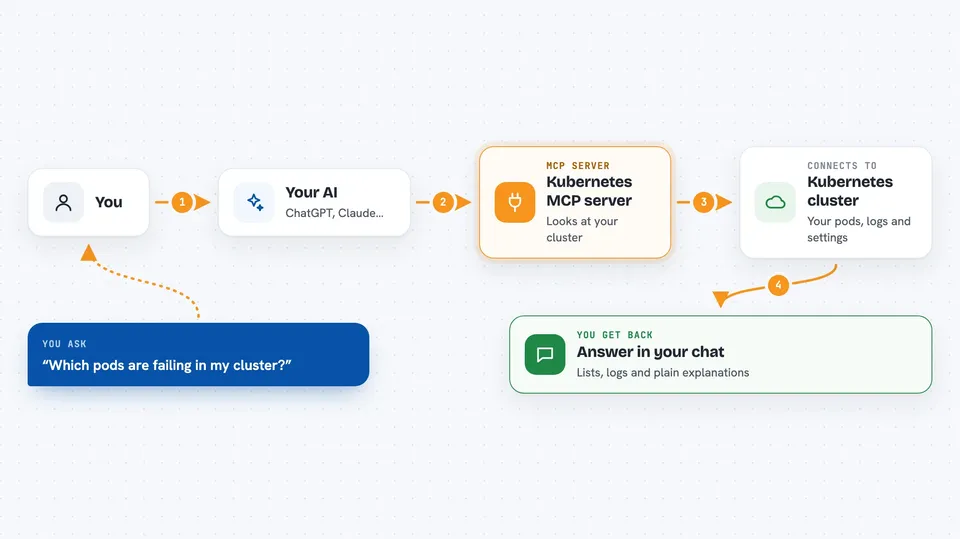
You ask your AI something like which pods are failing in a namespace. The AI sends that request to this helper program running on your computer. The helper talks to your Kubernetes cluster using your existing Kubernetes settings file. It then brings back the answer, such as a list of pods, their status, or log lines, and the AI explains it to you in the chat. If you have not turned on read-only mode, it can also create or change resources when you ask.
 Click to zoom
What you can do with it
- List your Kubernetes contexts and namespaces
- List, get, create, and modify Kubernetes resources like pods, services, and deployments
- List the nodes in your cluster
- Get recent events to see what is going wrong
- Read the logs of a pod
- Run a command inside a pod
Try asking your AI
- “Which pods are running in the kube-system namespace?”
- “Show me the last 50 log lines from the pod my-app-7d9f in the default namespace”
- “Are there any warning events in the last hour?”
- “List all deployments in the staging namespace and their replica counts”
What it gives back to you
You get answers in the chat: lists of pods, namespaces, nodes, or resources, with their status and basic details. Logs come back as text you can read or ask the AI to summarize. Events come back as a list of recent things that happened in the cluster. If you asked it to change something, it tells you what it did.
Before you start
What you need
- A Kubernetes cluster you can reach and a kubeconfig file (the settings file Kubernetes tools use to connect)
- Node.js if you install it with npm or npx, or Docker if you use the Docker image
- The Claude desktop app or another AI client that supports MCP servers
Good to know
If you do not turn on read-only mode, the AI can create or change resources in your cluster, so be careful which clusters you connect and consider limiting allowed contexts.
Install it with your AI
Add Kubernetes MCP server to your AI, no technical skills needed
You don't install anything by hand. You copy one prompt, paste it into an AI that can work on your computer, and it checks, installs and connects the server for you, asking you when it needs something.
Sign in to get the install prompt
Members get a ready-made prompt that lets the Claude desktop app check Kubernetes MCP server, install it and connect it for them, step by step. You don't need any technical skills: you copy, paste and answer a few questions. Your connected AI can also find and install any of the 4,609 MCP servers here for you.
Who it's for
Developers, DevOps engineers, and support staff who work with Kubernetes clusters and want to check or change things by asking in plain English.