MCP server · Notes
NexusMem memory server
by yaminbkk
Your AI remembers your old shell commands, errors and fixes, plus git changes and notes.

This is a memory helper that lives right on your computer. It quietly saves the commands you ran in your terminals, including ones that failed, along with your git activity and some documents. Later, when you ask your AI questions about your project, it pulls up the parts that matter so you don't have to remember everything yourself.
What is an MCP server? The 30-second version
By itself your AI can only talk based on what you put in front of it. An MCP server is a little companion program that adds a new ability to your AI. In this case the companion connects your AI to NexusMem, a personal notebook saved on your hard drive where your past commands and mistakes wait to help. So when you ask "has this ever worked?", the answer comes straight from your own logs.
What this MCP server does
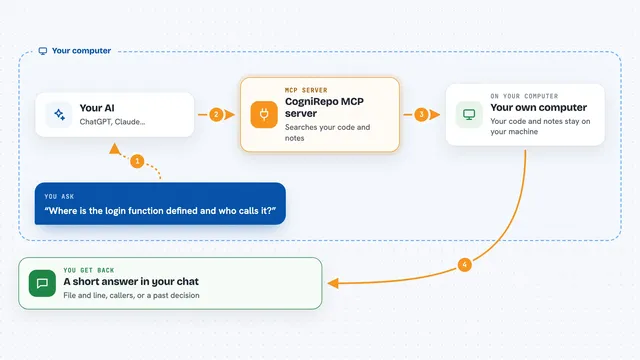
When you connect NexusMem, your AI gains access to three simple actions. First, whenever you want to know something, the AI searches your local memory store called NexusMem. Second, if your project hasn't been scanned yet, the AI triggers a quick update that collects recent commands, git edits and document snippets into that store. Third, the AI checks what's already known so it doesn't waste effort repeating scans. You keep asking natural-language questions, and behind the scenes the system finds the closest matches and feeds them back as clear text blocks in your chat.
 Click to zoom
What you can do with it
- Ask whether a particular build error appeared earlier today
- See which command finally solved a problem you struggled with yesterday
- Recall details of a bug fix committed weeks ago without leaving the chat
- Search documentation sections related to a topic instantly
- Check current storage size and latest captured events
Try asking your AI
- “Why did my tests suddenly stop passing around noon?”
- “Show me the sequence of steps I followed when setting up authentication last week”
- “Has 'docker compose up' ever succeeded on this branch?”
- “Find the paragraph in our design guide mentioning rate limits.”
What it gives back to you
Depending on your request, you'll receive compact lists of matching moments sorted by importance. Those might include lines showing a failed command beside the eventual success, quoted pieces from markdown guides, or brief descriptions of git patches. Numbers such as total items counted or timestamps often accompany results so you understand freshness. All displayed plainly in the chat thread without extra formatting fuss.
Before you start
What you need
- Node version 22 or higher
- Git available on your PATH
- Permission to create a hidden folder named .nexusmem wherever you plan to index
Install it with your AI
Add NexusMem memory server to your AI, no technical skills needed
You don't install anything by hand. You copy one prompt, paste it into an AI that can work on your computer, and it checks, installs and connects the server for you, asking you when it needs something.
Sign in to get the install prompt
Members get a ready-made prompt that lets the Claude desktop app check NexusMem memory server, install it and connect it for them, step by step. You don't need any technical skills: you copy, paste and answer a few questions. Your connected AI can also find and install any of the 4,609 MCP servers here for you.
Who it's for
Software developers, data scientists, or anybody juggling multiple coding tasks daily who wants instant recollection of previous attempts without hunting manually.