
AI news ·
Arbitrators may ask AI for legal views but must retain decision-making responsibility
A Québec court set aside an arbitral award in April 2026 after the arbitrator relied on non-existent AI-generated authorities. Arbitrators may use AI for research but cannot delegate the decision-making function itself.
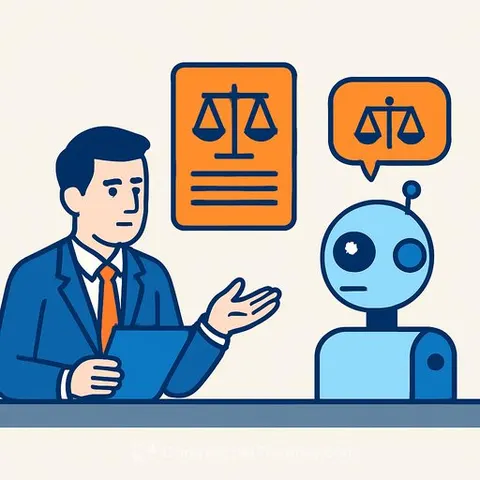
The use of artificial intelligence in international arbitration is raising a new and difficult question: can an arbitrator ask AI for its view on a legal issue the tribunal must decide? There is no blanket prohibition, but emerging guidance from leading arbitral institutions draws a clear line at delegating the decision-making function itself. The answer matters because improper reliance on AI can endanger an award, as a Québec court demonstrated in April 2026 when it set aside an award after finding that the arbitrator had relied on non-existent authorities generated by AI.
The distinction between assistance and adjudication
Arbitrators have long used research tools, legal databases, and tribunal secretaries without anyone suggesting they have surrendered their decision-making power. Asking an AI system to locate authorities on the interpretation of limitation clauses is functionally closer to legal research than adjudication. Asking it to identify possible counterarguments against a tentative interpretation can also assist analysis, provided the arbitrator evaluates those arguments independently.
The position becomes harder when the prompt itself asks the AI to perform the adjudicative exercise. Questions such as "Which party has the stronger argument?" or "How should the tribunal decide this jurisdictional objection?" ask the system to weigh competing positions and reach a conclusion. The relevant inquiry, therefore, is what task the AI is asked to perform and how its output is used.
Guidelines converge on a single principle
The 2025 Chartered Institute of Arbitrators Guideline on the Use of AI in Arbitration recognises that arbitrators may use AI tools to enhance efficiency and the quality of decision-making. It also provides that arbitrators should not relinquish their decision-making powers to AI. The guideline advises tribunals to avoid delegating tasks such as "legal analysis, research and interpretation of facts and law, or application of the law to the facts" where the use of AI could influence procedural or substantive decisions.
The Silicon Valley Arbitration & Mediation Center Guidelines adopt a similar approach. Guideline 6 states that an arbitrator may not delegate any part of the arbitrator's personal mandate to an AI tool and that AI must not replace the arbitrator's independent analysis of the facts, law, and evidence. Although expressed differently, these instruments draw the same line: AI may assist the tribunal, but it cannot replace the tribunal's judgment.
The tribunal secretary analogy - and its limits
Existing rules governing tribunal secretaries provide a useful comparison. Under the 2020 LCIA Arbitration Rules, tribunals may obtain assistance from secretaries but "under no circumstances" may they delegate the decision-making function. The 2026 ICC Rules similarly provide that a secretary works under the tribunal's direction and may not exercise any decision-making authority.
The analogy is not exact. A tribunal secretary is an identified individual whose obligations of independence and confidentiality are addressed. An AI system is not subject to equivalent personal obligations, and the arbitrator may have limited visibility into its sources, processing, or retention of information. These differences become more significant where AI moves beyond retrieving information and begins to analyse the parties' positions or formulate legal conclusions.
Confidentiality, accuracy, and the risk of fabricated material
International arbitration often involves commercially sensitive material. Uploading pleadings, witness statements, or expert reports into an inadequately secured AI system creates risks concerning data retention, access, and use for training. The Ciarb AI Guideline stresses that third-party AI systems may create significant confidentiality and cybersecurity risks.
Generative AI can also produce false authorities, incorrect propositions of law, or persuasive explanations that conceal significant errors. An arbitrator who uses AI-generated research remains responsible for checking the underlying authority rather than treating the AI response as a legal source. Independent verification requires more than confirming that cited cases exist. The arbitrator must independently examine the relevant law and reach their own conclusion.
When AI use threatens the award
Consequences of improper AI use have begun to surface before national courts. In April 2026, the Québec Superior Court set aside an award after finding that non-existent authorities and doctrine were central to the arbitrator's reasoning and that the circumstances demonstrated uncontrolled use of AI and an improper delegation of part of the adjudicative task. The Court did not treat the mere use of AI as a ground for annulment. The problem was the arbitrator's reliance on fabricated material, failure to verify the result, and the resulting departure from the procedure agreed by the parties.
Depending on the applicable arbitration law, excessive or unverified AI involvement could give rise to challenges concerning a party's inability to present its case, a departure from the agreed arbitral procedure, or conflict with public policy. At the enforcement stage, analogous grounds appear in the New York Convention.
Why this matters for legal professionals
For arbitration practitioners, the practical dividing line is not whether an arbitrator ever asks AI what it "thinks," but whether the analysis and decision remain genuinely those of the arbitrator. Routine legal research and document review, tasks central to the AI Learning Path for Paralegals, sit on the permissible side of the line. Asking AI to evaluate competing submissions or recommend an outcome does not. The safest course when AI identifies a novel legal theory that becomes material to the outcome is to put the issue to the parties rather than silently incorporate it into the award. For professionals working in AI for Legal roles, the emerging consensus is clear: the arbitrator must own the reasoning, and the parties must have a genuine opportunity to be heard on it.