
AI news ·
Bank of England governor warns AI stock trading erodes price signals as humans cannot understand machine judgment
Bank of England Governor Andrew Bailey warns G20 ministers that AI trading could destabilize markets because humans cannot read AI's judgment, eroding the informational value of prices.
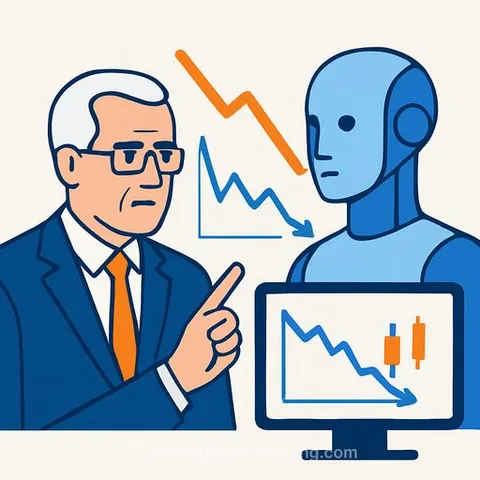
Andrew Bailey, Governor of the Bank of England and chair of the Financial Stability Board, has warned G20 finance ministers that the spread of artificial intelligence in trading could destabilize core mechanisms of financial markets. His letter, reported by the Financial Times, highlights a specific danger: AI can read human behavior, but humans cannot read AI's judgment, potentially eroding the informational value of prices themselves.
The risk of an AI-driven bubble and concentrated cyber threats
Bailey's letter identifies two immediate structural risks. The first is an AI bubble. Cross-investment between AI firms and big tech has driven high corporate valuations and market concentration. If the AI boom cools, the leverage embedded in these positions means a sharp decline in asset values could spread quickly across the financial system.
A second risk is the amplification of cyber threats. Financial institutions often depend on a small number of external IT service providers. A successful AI-powered cyber attack that suspends core services at one of these providers could undermine trust in the entire financial system, rather than just a single firm.
Asymmetric understanding: when AI reads humans but humans cannot read AI
Markus Brunermeyer, a professor at Princeton University, describes a deeper structural problem as "asymmetric understanding." AI agents can predict human trading behavior by processing vast datasets. But the logic behind an AI's decision to buy or sell a stock remains opaque to human observers. The judgment is a generated output, and the process generating it is not transparent.
This opacity has direct consequences for price discovery. In markets where AI agents actively trade, the price of an asset carries less information. If participants cannot infer why a trade occurred at a given price, they cannot read the judgments and expectations of other actors through that price signal. The value of the information provided by the price falls.
"AI reads humans, but humans can't read AI," Brunermeyer said, summarizing the core asymmetry. Bailey's letter reflects this concern, warning that the existing formula of financial markets could be shaken.
Policy responses and cautious skepticism
Brunermeyer argued that central banks should shift focus toward policy instruments that operate directly, such as reserve requirements, rather than relying heavily on influencing markets and expectations. He also suggested that regulators consider partially separating certain market segments to prevent contagion when problems arise in one area.
Raguram Rajan, a professor at the University of Chicago, agreed that AI introduces new risks but cautioned against drawing firm policy conclusions too soon. The mechanisms are still emerging, and the data on how AI agents interact in stressed markets is limited.
Why this matters for finance professionals
For traders, risk managers, and CFOs, the warning targets a practical blind spot. Models that treat price as a reliable summary of market sentiment assume that human-readable intent sits behind every trade. When AI execution lacks explainability, that assumption weakens. Professionals building or overseeing AI for Finance systems need to assess how much their strategies depend on reading the intentions of other market participants. For senior finance leaders, understanding these structural shifts is no longer optional. An AI Learning Path for CFOs can provide the technical context needed to govern these risks before a liquidity event exposes the gap between algorithmic action and human oversight.