
AI news ·
Chinese courts rule companies cannot fire workers to replace them with AI
Chinese courts ruled companies cannot fire workers simply to adopt AI, treating automation as a deliberate business choice. Two separate cases awarded compensation to employees whose roles were eliminated after AI replaced their work.
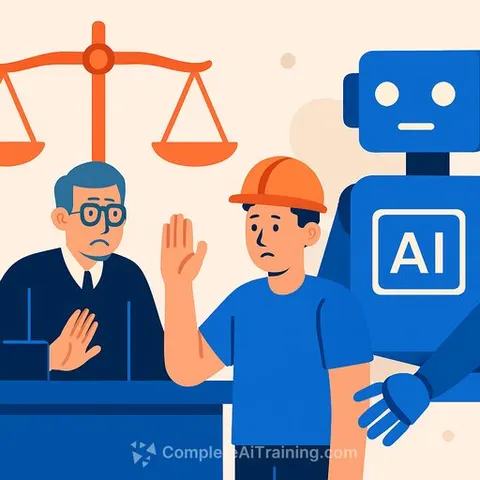
China's Courts Rule Companies Cannot Use AI as Justification for Mass Layoffs
Chinese courts have established that companies cannot terminate employees simply to replace them with AI systems. Two separate rulings put the cost of technological transformation on employers rather than workers, creating a legal framework that treats AI adoption as a deliberate business choice-not an unavoidable circumstance.
The Hangzhou Intermediate People's Court upheld a decision against a tech firm that had demoted and then fired a quality assurance worker after concluding his role verifying AI-generated content was redundant. The worker, identified as Zhou, earned 25,000 yuan ($3,640) monthly. When the company offered him a lower-level position paying 15,000 yuan-a 40 percent pay cut-he refused. The company terminated his contract. Arbitration, district court, and appellate court all ruled against the employer and awarded Zhou compensation.
The court's reasoning carries weight for HR professionals. Judges found that integrating AI into business operations is a deliberate strategic decision, not an unforeseeable shift in circumstances. China's Labour Contract Law permits termination when fundamental changes make a contract unworkable, but courts have traditionally reserved that language for disruptions no employer could prevent-natural disasters, government-ordered relocations. Because the company chose to adopt AI, it could not invoke that provision to justify the firing.
A second case reinforced the principle. Liu had spent fifteen years doing manual map data entry at a tech company. In early 2024, the company replaced all manual work with AI tools, closed his division, and terminated his job while claiming unexpected circumstances forced the decision. Again, arbitration, trial, and appeals courts disagreed, ruling that automation is a normal business decision and employers bear the risk of any resulting job losses.
The Hangzhou court suggested that if companies need to restructure because of AI, they should focus on retraining employees for roles requiring human judgment. Any new positions offered should come with fair compensation.
The Global Employment Divide
These Chinese rulings stand alone. No equivalent protection exists in the United States or the European Union.
In the U.S., the at-will employment doctrine-applicable in all but one state-permits employers to end jobs for virtually any reason. AI-driven displacement falls outside the narrow list of terminations the law actually prohibits. The EU's AI Act designates systems used in hiring and performance review as high-risk, requiring transparency and oversight, but the regulation governs how those tools are used, not whether companies may restructure around them.
By April 2026, more than 78,000 tech jobs had been cut globally, with roughly half linked directly to AI. China's urban youth unemployment rate reached 15.3% in March, giving the government both political and economic reasons to treat mass layoffs as a stability threat.
The "AI-Washing" Question
Management experts increasingly question whether companies are accurately attributing layoffs to AI. Some executives may invoke AI as cover for restructuring driven by over-hiring, margin pressure, or strategic missteps-a phenomenon described as "AI-washing."
The Chinese rulings create a legal consequence for that framing. If a company claims AI drove a termination, it is now invoking a rationale courts have twice rejected as grounds for dismissal. For HR leaders, this matters: the burden shifts to proving that AI adoption was genuinely necessary and that alternatives to termination were exhausted.
Learn more about AI for Human Resources and how workforce strategy intersects with AI adoption. HR executives may also find value in the AI Learning Path for CHROs, which covers workforce analytics and talent management in the context of AI implementation.