
AI news ·
Employees aren't resisting AI, they're grieving the work they loved, says HR chief
Some employees aren't resisting AI out of fear - they're grieving the work they loved. HR leaders say the fix starts with listening, not reassuring.
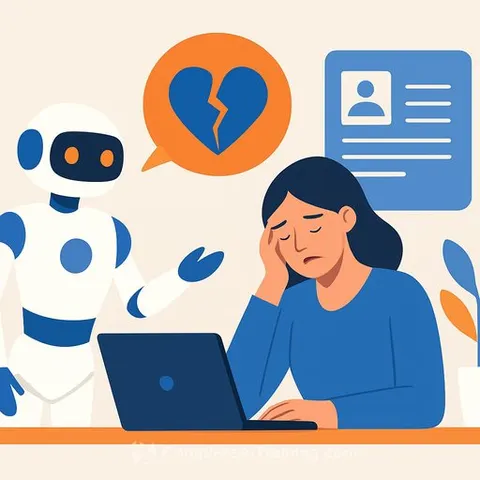
Your employees may be grieving their old jobs. Here's how to help them through it.
Kristin Supancich, Chief People Officer at Ahead, sat down with an engineer who had spent 30 years working with network infrastructure. He wasn't angry about AI adoption. He wasn't afraid of losing his job. He just missed his work.
"I've been an engineer for 30 years," he told her. "I love tinkering. I love being in it. I like to watch how it's happening. And I don't trust it yet. And I miss the tinkering."
His role still existed and remained meaningful. But the part that had given him pleasure and identity for three decades was gone. An AI agent now did the tinkering. He read the output.
That conversation reshaped how Supancich thinks about resistance to AI in the workplace. What if the pushback HR leaders encounter isn't really about fear of replacement, but about something more fundamental: grief over losing work that people genuinely enjoyed?
She had recently encountered work by a psychologist exploring this exact dynamic. The concept was straightforward: people are leaving what they knew for a long time and what they found joy in. While they're excited about the future, the anxiety might not be about job loss at all. It might be about grieving something they're losing that they really enjoyed.
Where the grief shows up
At Ahead, an enterprise cloud solution and IT services provider, engineers and salespeople largely embraced AI tools with enthusiasm. But in parts of the business built around process-driven, repetitive tasks, the response was different and more hesitant.
Supancich's hypothesis: people who had done the same job for years liked the step-by-step process. The thought of reimagining what they'd do if they didn't do that work anymore created real discomfort.
Her response wasn't to push harder or add more training. It was to listen.
She encouraged Ahead's senior leaders to resist the instinct to reassure and instead create real space for people to voice what was worrying them. "If someone's not embracing it, instead of using the stick, it's like, let's talk about what's making you nervous," she said. "Let me give you the realities of what's really going to happen versus the fear of the unknown."
She's also candid that fear of job loss is real and shouldn't be brushed aside. Employees read the headlines. But she believes the grief framing opens a more honest conversation, one that gets closer to what people are actually experiencing.
Ahead's most recent engagement survey suggests the listening-first approach is working. Four AI-specific questions covering leader support, daily usage, and confidence with the tools all scored in the 80th percentile. "I was actually really excited and quite amazed at how high it was," Supancich said.
When it's your own job that's changing
What makes Supancich's perspective particularly credible is her willingness to apply it to herself. When she first read about grief in the context of workplace change, it didn't just clarify what she was seeing in her employees. It clarified something she recognized in herself.
One of her acknowledged strengths as a people leader is her ability to connect with employees, to read a room, to look someone in the eye. As AI absorbs more operational work and the workforce potentially shifts toward a blend of human and digital employees, she wonders what becomes of that ability.
"If my employees in the future are not human and I have less of them and work is going so fast that this is a waste of time," she said, "I'm not going to like that as much. I enjoy this. So, I do think there's a sense of grief that I feel."
She's also noticed smaller losses. As AI rewrites workplace emails into clean, bulleted language, individual voices are quietly disappearing. "I know the way that so-and-so writes to me, and at the end he makes a funny joke and there's an emoji, and that kind of lightens my day," she said. "I don't want companies to become just monotone speak."
It's a minor thing, she acknowledges. It's still something she will miss.
During the COVID pandemic, Supancich found herself fielding questions about disease protocols and physical distancing - territory that had nothing to do with her HR background. Now, navigating AI infrastructure feels like another version of the same thing: a role quietly expanding into places she never trained for.
"I didn't know I needed to be a doctor," she said. "I also didn't know that I had to be an infrastructure engineer. I know more than I thought I could, and I need to know a lot more."
Leading people through loss
Supancich's advice starts with acknowledgment. Sit with what people are losing before trying to move them forward.
"We not only lead in the transformation," she said, "but we're going to have to hear these things and then help people make the transition from grief to back to excitement again, just like all the stages of change."
The reframe isn't about minimizing what's being lost. It's about helping people find meaning in what their work is becoming and trusting that excitement will follow once the grief has been heard.
Change has always involved loss. But the losses this time are quieter and more personal, tied not to jobs disappearing but to the parts of work that gave people identity and joy. Naming that honestly is what makes the transition possible.
For HR leaders, that's where the real work begins.
Learn more: AI for CHROs (Chief Human Resources Officers) covers how HR professionals can lead organizational change and support employees through AI adoption.