
AI news ·
D.C. appeals court faults Deutsche Bank lawyers for citing AI-hallucinated cases
A D.C. appeals court struck a Deutsche Bank subsidiary's brief after it cited AI-generated fake cases, calling the incident a "cautionary tale" and referring the matter for attorney discipline.
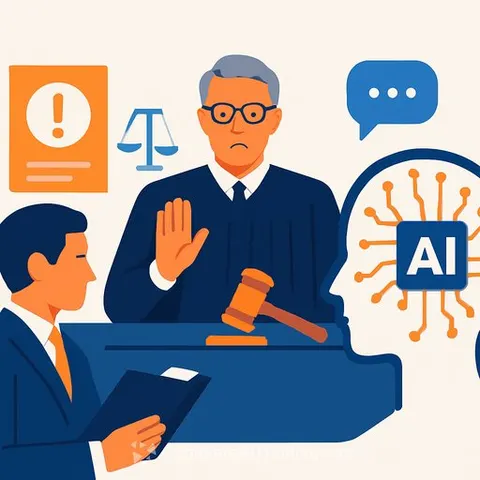
The District of Columbia Court of Appeals on Thursday faulted lawyers for a Deutsche Bank subsidiary for filing a brief that cited nonexistent cases generated by artificial intelligence, calling the incident a "cautionary tale" about misuse of the technology in legal practice.
The appeals court, Washington's highest local court, said it could not locate or confirm multiple citations in a brief submitted by Deutsche Bank National Trust, which was acting as trustee for a securitized mortgage trust in a foreclosure case. The court struck the brief and referred the matter to D.C.'s attorney discipline arm for investigation.
An outside lawyer for the bank, Loishirl Hall, apologized in a court filing and said she used a Google AI program to help prepare the brief. She said she took steps to verify the citations before submission. The appeals court acknowledged Hall took ownership of the error but added that "every firm attorney who signed the brief bears some responsibility."
A firm policy that wasn't followed
Hall's firm at the time, McCabe, Weisberg & Conway, told the court it does not permit employees to use AI for "drafting of any legal correspondence or documents." Neither Hall, Deutsche Bank, nor the McCabe firm immediately responded to requests for comment.
The D.C. Court of Appeals said this was the first case in which it encountered a brief containing fabricated citations. The court noted that AI use in the legal industry is now so widespread that "attorneys can no longer credibly claim ignorance of its pitfalls, including its propensity to hallucinate legal authority."
Judges warn against avoidance, not use
A panel of judges emphasized the ruling was not meant to discourage AI adoption. "Our intent is not to discourage attorneys from using AI - indeed, we have reached a point where attorneys eschew at least an understanding, if not use, of AI at their own peril - but to emphasize the importance of doing so discerningly and responsibly," the panel said.
Judge Stephen Glickman, writing separately, described striking the brief as an "appropriate but comparatively weak response that unfortunately penalizes the innocent client for its counsel's offense." He suggested the full appeals court may want to address the situation further.
For legal professionals, the case underscores that understanding how to use AI tools responsibly is no longer optional. Training on AI for Legal applications can help attorneys avoid precisely the kind of citation verification failures that led to this ruling, while still benefiting from the efficiency gains the technology offers.
Why this matters for legal professionals
This ruling signals that courts will hold lawyers personally accountable for AI-generated errors, even when firm policies prohibit the practice. The takeaway is not to avoid AI - the court explicitly warned against that - but to build verification workflows that catch hallucinations before they reach a judge. For associates and partners alike, the competence bar has shifted: knowing how to prompt, check, and validate AI output is now a baseline professional obligation, not a specialization.