MCP server · Notes
ContextForge MCP server
by alfredoizdev
Give your AI coding assistant a long-term memory so it remembers your project across sessions.

ContextForge is a helper that gives your AI assistant a lasting memory of your project. Instead of re-explaining your setup, decisions, and to-dos every time you start a new chat, your AI can look them up and save new ones. It is handy for anyone who works with an AI coding assistant like Claude Code, Cursor, or GitHub Copilot and is tired of repeating themselves.
What is an MCP server? The 30-second version
On its own, your AI can only chat with what is in the current conversation. An MCP server is a small helper program that gives your AI a new skill or a connection to another service. This one connects your AI to ContextForge, a place online where your project notes and decisions are stored. Once connected, your AI can save things there and look them up again later, even in a brand new chat.
What this MCP server does
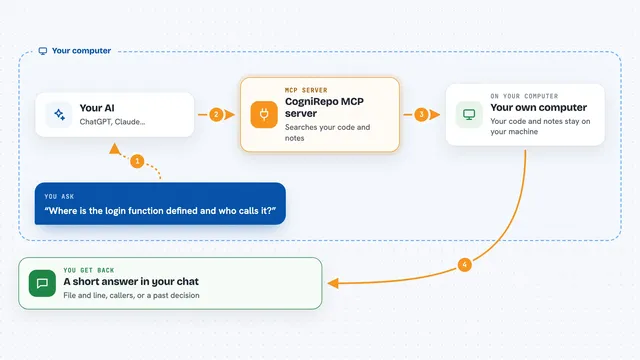
You tell your AI something worth remembering, like which database you use or why you made a choice. Your AI sends that to the ContextForge helper, which stores it in your account online. Later, when you ask a question, your AI searches that stored knowledge by meaning, not just exact words, and brings back the most relevant notes. It can also pull in your Git commits and pull requests, track issues, and share a project with teammates. Everything shows up in your chat as answers, lists, or short summaries.
 Click to zoom
What you can do with it
- Save project decisions and notes so they survive across sessions
- Search your saved knowledge by meaning instead of exact keywords
- Connect a GitHub repo and pull in commits and pull requests
- Create, assign, and resolve issues for your project
- See what other live sessions are working on before you touch shared files
- Share a project with teammates by email
- Back up and restore your memory with snapshots
Try asking your AI
- “Save this: we use PostgreSQL for the main database”
- “What database do we use?”
- “What commits did I make today?”
- “What should I work on next?”
What it gives back to you
You get answers in plain chat, like a short summary of what your AI found or a list of your open issues. When it saves something, it tells you it was stored. When you ask about commits or pull requests, it shows a list with titles and dates. You can also ask for a backup or an export, and it will hand you a file.
Before you start
What you need
- A free ContextForge account at contextforge.dev
- An API key from your ContextForge dashboard (a kind of password for apps; the site gives you one for free)
- An AI tool that supports MCP, like Claude Desktop, Claude Code, Cursor, or GitHub Copilot in VS Code
- Node.js installed on your computer, since the helper runs through npx
Good to know
It can save, change, and delete things in your ContextForge account, so be clear about what you want removed or overwritten.
Install it with your AI
Add ContextForge MCP server to your AI, no technical skills needed
You don't install anything by hand. You copy one prompt, paste it into an AI that can work on your computer, and it checks, installs and connects the server for you, asking you when it needs something.
Sign in to get the install prompt
Members get a ready-made prompt that lets the Claude desktop app check ContextForge MCP server, install it and connect it for them, step by step. You don't need any technical skills: you copy, paste and answer a few questions. Your connected AI can also find and install any of the 4,361 MCP servers here for you.
Who it's for
Developers and anyone who uses an AI coding assistant daily and wants it to remember their project without repeating themselves.