MCP server · Social media
YouTube MCP server
by Klavis-AI
Lets your AI pull YouTube video transcripts, details, search results, channel info and playlists when you ask.
This is a small helper that connects your AI assistant to YouTube. Once it is set up, you can ask your AI things like what a video says or which videos a channel has posted, and it goes and fetches the answer for you. It is handy for anyone who watches, studies from, or keeps track of YouTube videos as part of their work.
What is an MCP server? The 30-second version
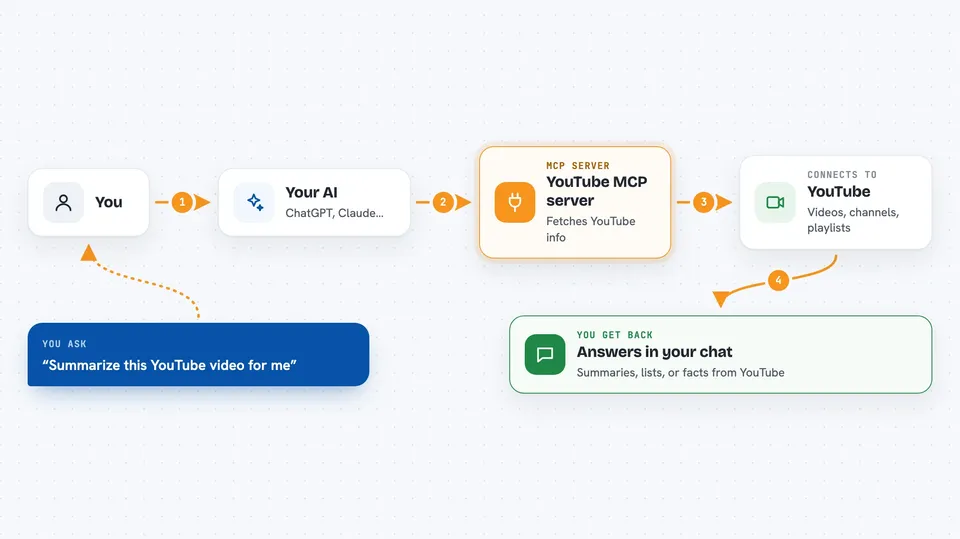
On its own, your AI can only chat with you using what it already knows. An MCP server is a small helper program that gives your AI one new skill, in this case the ability to look things up on YouTube. When you ask a question about a video or a channel, your AI sends the request to this helper, the helper talks to YouTube, and the answer comes back into your chat. You do not need to understand how it works inside; you just need it connected once.
What this MCP server does
You ask your AI something about YouTube, like what a video covers or which videos a channel has posted. Your AI passes that request to this helper program. The helper talks to YouTube's own service using a key you provide, and asks for the transcript, the video details, the search results, the channel info, or the playlist contents. YouTube sends the data back, and the helper hands it to your AI. Your AI then writes it up for you in the chat, as a summary, a list, or a set of facts.
 Click to zoom
What you can do with it
- Get the full transcript of a YouTube video, with timestamps
- Look up a video's title, description and statistics
- Search YouTube for videos by keywords and filters
- Get details about a channel and the videos it has posted
- Read the contents and details of a playlist
- Summarise what a long video is about without watching it
Try asking your AI
- “Give me the transcript of this YouTube video and summarise the main points”
- “What is this video about? Here is the link”
- “Search YouTube for beginner Excel tutorials and list the top five”
- “What videos has this channel posted recently? Here is the channel link”
What it gives back to you
You get answers written in the chat, based on real YouTube data. That might be a transcript with timestamps, a summary of a video, a list of search results, or facts like a video's title, description and view counts. For channels and playlists you get lists of videos with their details. Nothing on YouTube is changed; it only reads information.
Before you start
What you need
- A YouTube Data API key from the Google Cloud Console, with the YouTube Data API v3 turned on (this is a kind of password that lets apps ask YouTube for data)
- An AI assistant that can use MCP servers, such as the Claude desktop app
- Either a free Klavis API key (if you use their hosted service) or Docker on your computer (if you run it yourself)
Good to know
It only reads public YouTube information, but it needs your YouTube Data API key, so keep that key private and do not share it with anyone.
Install it with your AI
Add YouTube MCP server to your AI, no technical skills needed
You don't install anything by hand. You copy one prompt, paste it into an AI that can work on your computer, and it checks, installs and connects the server for you, asking you when it needs something.
Sign in to get the install prompt
Members get a ready-made prompt that lets the Claude desktop app check YouTube MCP server, install it and connect it for them, step by step. You don't need any technical skills: you copy, paste and answer a few questions. Your connected AI can also find and install any of the 4,361 MCP servers here for you.
Who it's for
Anyone who works with YouTube content, such as researchers, marketers, teachers, students, and writers who need to read or summarise videos quickly.