MCP server · Security
RAD Security MCP server
by rad-security
Lets your AI look up Kubernetes and cloud security findings, images, and runtime data from RAD Security.

This is a helper that connects your AI assistant to RAD Security, a tool that watches over your Kubernetes clusters and cloud setup for security problems. Once it is connected, you can just ask your AI questions about your findings, images, or containers instead of clicking around a dashboard. It is handy for anyone who deals with cloud security but does not want to learn every screen of the RAD Security console.
What is an MCP server? The 30-second version
On its own, your AI can only chat with you. An MCP server is a small helper program that gives your AI a new skill or a connection to another service. This one connects your AI to RAD Security, so when you ask a question about your clusters or findings, the AI can go look it up there and bring the answer back to you. You do not need to understand how it works under the hood, you just add it once and then talk to your AI like normal.
What this MCP server does
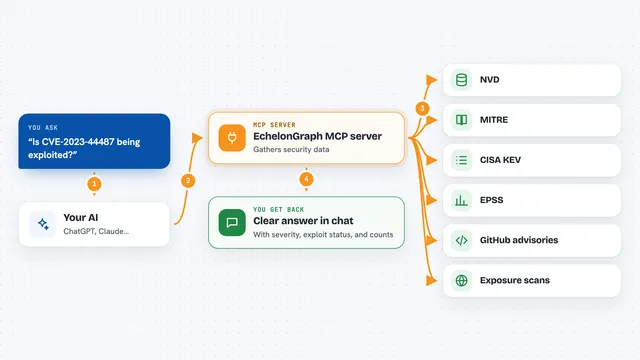
You type a question in your AI chat, like asking which images have the most vulnerabilities. The AI sends that request to this helper, which talks to the RAD Security service on your behalf. RAD Security sends back the data, and the helper hands it to your AI. Your AI then writes it up for you in plain words, as a list, a summary, or a table. Some actions can also change things in RAD Security, like updating a finding's status or running an automation.
 Click to zoom
What you can do with it
- List your clusters and containers with their details
- Look up security findings and update their status
- See which images have the most vulnerabilities
- Check who shelled into a pod
- Look at process trees and runtime baselines for running containers
- Search the knowledge base and run queries with RadQL
- List automations, run one, or create a new schedule
Try asking your AI
- “What are my top 10 most vulnerable images right now?”
- “Show me all open security findings for the production cluster.”
- “Who shelled into a pod in the last 24 hours?”
- “List my automations and tell me when the next one runs.”
What it gives back to you
You get answers written in plain language, usually as a list or a short summary. For example, a list of images with their vulnerability counts, or a table of findings with severity and status. If you asked it to change something, like marking a finding as resolved, it tells you that the change was made. Everything shows up right in your chat window.
Before you start
What you need
- A RAD Security account
- A RAD Security API access key (an ID and secret you create in the RAD Security console)
- Your RAD Security account ID
- An MCP client that supports remote servers, like Claude, Cursor, or VS Code
Good to know
Some tools can change things in RAD Security, like updating a finding's status or running an automation, so be careful when you ask your AI to make changes.
Install it with your AI
Add RAD Security MCP server to your AI, no technical skills needed
You don't install anything by hand. You copy one prompt, paste it into an AI that can work on your computer, and it checks, installs and connects the server for you, asking you when it needs something.
Sign in to get the install prompt
Members get a ready-made prompt that lets the Claude desktop app check RAD Security MCP server, install it and connect it for them, step by step. You don't need any technical skills: you copy, paste and answer a few questions. Your connected AI can also find and install any of the 4,609 MCP servers here for you.
Who it's for
Security engineers, DevOps folks, and anyone who manages Kubernetes or cloud security and wants quick answers without opening a dashboard.