MCP server · Notes
deja-vu memory server
by vshulcz
Your AI can search your past coding sessions from Claude Code, Codex and other agents, so it remembers what you already fixed.

deja-vu is a memory tool for your coding assistant. It reads the session history that tools like Claude Code and Codex already saved on your computer, then lets your AI search that history when you ask about something you did before. It is handy if you keep solving the same problem twice, or if you switch between different AI coding tools and lose track of what you decided.
What is an MCP server? The 30-second version
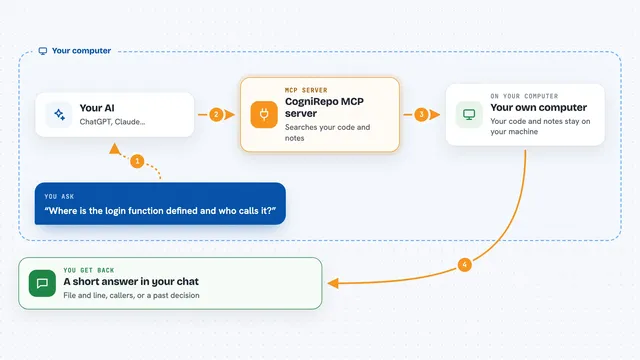
On its own, your AI can only chat with you in the current session. An MCP server is a small helper program that gives your AI a new skill or a connection to something outside the chat. This one connects your AI to your own past coding sessions stored on your machine. When you ask a question, the AI calls this helper, the helper searches your old session history, and the AI gets the relevant bits back to answer you.
What this MCP server does
You ask your AI something like whether you dealt with a certain error before. The AI calls deja-vu through the MCP connection. deja-vu searches an index it built from the session histories already on your disk, from tools like Claude Code, Codex, Cursor and others. It finds matching sessions and hands back short summaries, file names and decisions. Your AI then uses that to answer you, so you do not have to remember or re-debug it yourself.
 Click to zoom
What you can do with it
- Search all your past coding sessions for a topic or error message
- See which files were touched when you worked on a subject
- Find out what the last session in a folder was doing
- Check which sessions discussed a specific file and what was decided
- Look up how a command was actually run on your machine before
- See what you ran after the same error in the past, when it worked
- Spot errors that keep coming back across many sessions
Try asking your AI
- “Have we dealt with jwt refresh rotation before? check your memory”
- “Which files did we change when we set up the login flow?”
- “What was the last session in this folder working on?”
- “Did we ever fix a connection pool exhausted error, and how?”
What it gives back to you
You get back short text summaries in the chat, with the session name, the date and the matching lines. Sometimes it shows file names, commands and whether they failed. If you ask for more detail, your AI can pull a longer markdown digest or list of related files. The answers come from your own history, not from the internet.
Before you start
What you need
- A Mac, Linux or Windows computer
- At least one coding agent that keeps session history, like Claude Code or Codex
- The deja-vu program installed (the install script or a package manager does this)
Good to know
It reads your local session history, which may contain secrets or private code, so check the redaction and exclusion settings before sharing anything.
Install it with your AI
Add deja-vu memory server to your AI, no technical skills needed
You don't install anything by hand. You copy one prompt, paste it into an AI that can work on your computer, and it checks, installs and connects the server for you, asking you when it needs something.
Sign in to get the install prompt
Members get a ready-made prompt that lets the Claude desktop app check deja-vu memory server, install it and connect it for them, step by step. You don't need any technical skills: you copy, paste and answer a few questions. Your connected AI can also find and install any of the 4,609 MCP servers here for you.
Who it's for
Developers and anyone who uses AI coding assistants daily and wants them to remember past work across tools.