
AI news ·
Chinese firms quietly cut jobs through AI adoption as Beijing balances productivity push with stability concerns
Chinese firms are quietly laying off workers in small waves as AI tools replace their tasks, sidestepping labor laws that require government approval for large-scale cuts. Analysts estimate 70 million Chinese jobs face high displacement risk.
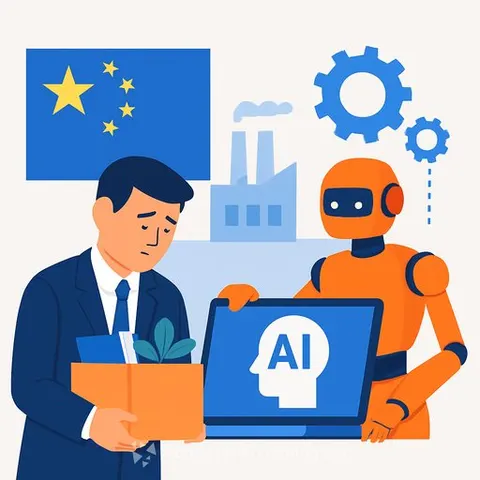
Chinese Companies Quietly Cut Jobs as AI Adoption Accelerates
Chinese firms are laying off workers in small, gradual waves rather than announcing mass cuts, a strategy driven by government pressure to adopt AI while avoiding the social instability that comes with visible job losses. Workers across tech, entertainment, and advertising say their employers began quietly firing staff in recent months after deploying AI tools that automate their tasks.
Liu, a 26-year-old contractor at a large internet firm in Hangzhou, said her employer started removing contractors in March after mandating use of an AI agent called OpenClaw. "The tasks most people do can be completely replaced by OpenClaw," she said. "After a person writes all their workflows into OpenClaw, they can basically be fired."
This approach contrasts sharply with Western tech companies. Meta and others have announced massive layoffs tied to AI adoption, triggering backlash in their home markets. Chinese firms face a different constraint: Beijing wants rapid AI adoption to boost productivity, but not at the cost of mass unemployment that could destabilize society.
Legal and Political Pressure
Chinese labour law requires government approval for workforce cuts exceeding 10% of staff. Chinese courts have ruled against at least three companies that dismissed workers specifically to replace them with AI tools.
A senior manager at a major Chinese fintech company told Reuters that "private companies will need to make room for some level of inefficiency in order to avoid mass layoffs that would prompt social instability and could have political ramifications."
Restructuring is already underway at major tech firms. An engineer at Alibaba's cloud division said AI-driven headcount reductions are unfolding through gradual cuts and attrition rather than formal layoff rounds. Marketing and front-end roles have been largely replaced by AI, according to multiple sources.
Measuring AI Adoption as Job Performance
Some companies are measuring whether employees adopt AI fast enough. A data engineer at a Chinese tech giant said his manager began ranking employees by "token usage" - a measure of AI compute consumption - starting in March. The metric now affects performance reviews and promotion prospects.
"It is relatively forced," the engineer said. "One should not use AI for the sake of it. I still can't shake the feeling that I'm getting closer to being replaced."
Entertainment has seen the most visible disruption. Micro drama studios are shifting to AI-generated actors and sets. Ayase, a 22-year-old producer fired in February, said her production department shrank from 30-40 people to about 10, with only two retained for live-action filming. Live actors cost thousands of yuan per day, even for minor roles.
Job Creation Lags Behind Displacement
Beijing's "AI Plus" initiative targets 70% AI adoption across key sectors by 2027 and 90% by 2030. Analysts warn the transition will be painful: job creation from AI is not keeping pace with job losses.
AI-related job postings surged 74% in 2025. Yet 12.7 million university graduates faced the job market last year with declining entry-level pay and fewer openings. Citibank estimated that 9.6% of all Chinese jobs - roughly 70 million - face high risk of AI displacement. For workers in their 20s, that risk rises to 13.6%.
The hashtag "AI anxiety" gained over 7.8 million views on Chinese social media, with users comparing themselves to 19th-century weavers displaced by power looms. Some AI tools are explicitly marketed to replace entire departments. Alibaba's Wukong platform, for example, offers pre-set "one-person company" skills designed to automate e-commerce sales, livestreaming, and software development.
Government Response Remains Limited
Chinese state media have tried to reassure workers that AI won't "steal people's rice bowls." Officials are studying AI's employment impact and reskilling programs, but have not released detailed policy responses.
Selena Guo, a social policy analyst, said the challenge is that "AI sits at the centre of China's economic transition in a particular way: it is simultaneously a driver of the disruption and the proposed solution to it." The government hopes rapid AI adoption will create a positive cycle of productivity and growth.
For now, workers face uncertainty. Liu, who works in content operations, said those who don't use AI risk being eliminated. "AI penetrating every aspect of life is only a matter of time," she said. "I want to go back to farming, or become an artisan."
For professionals in AI for Human Resources and those managing workforce transitions, understanding how AI Agents & Automation reshape employment is becoming essential.