AI tool
Atlaso
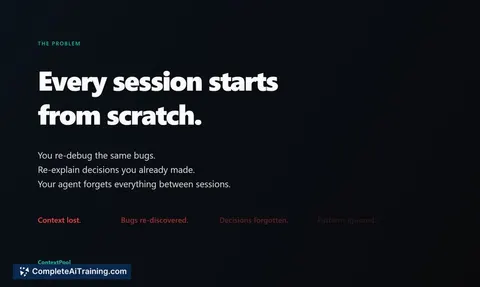
Atlaso is a persistent memory layer for AI tools that carries your context across sessions and apps. It stores global and per-project memories and shows a short orientation before you type, so the AI picks up where you left off. For developers usi...
About Atlaso
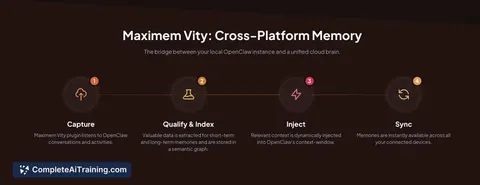
Atlaso is a memory layer for AI tools. It connects once and every AI you use - from Claude Code to Cursor, Codex and ChatGPT - automatically recalls context about your projects, decisions, and work preferences. The tool captures decisions and preferences out of your sessions and injects relevant ones at the top of your next prompt.
Review
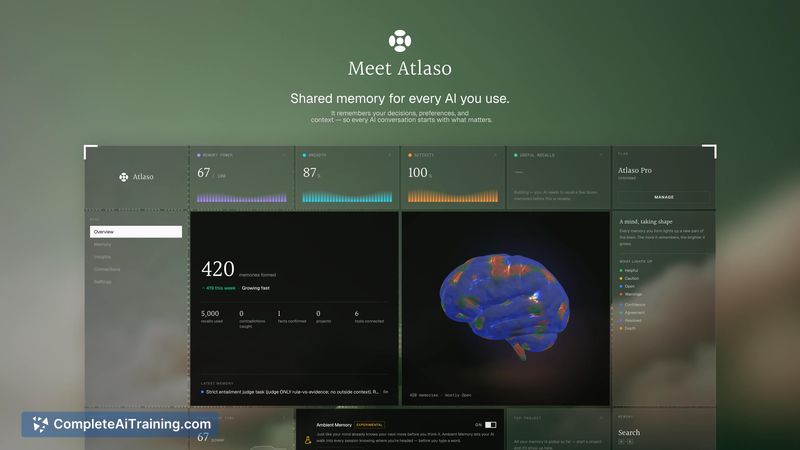
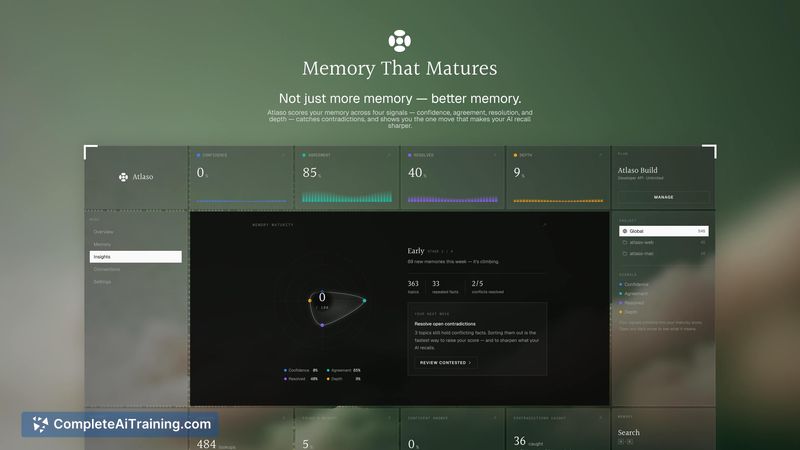
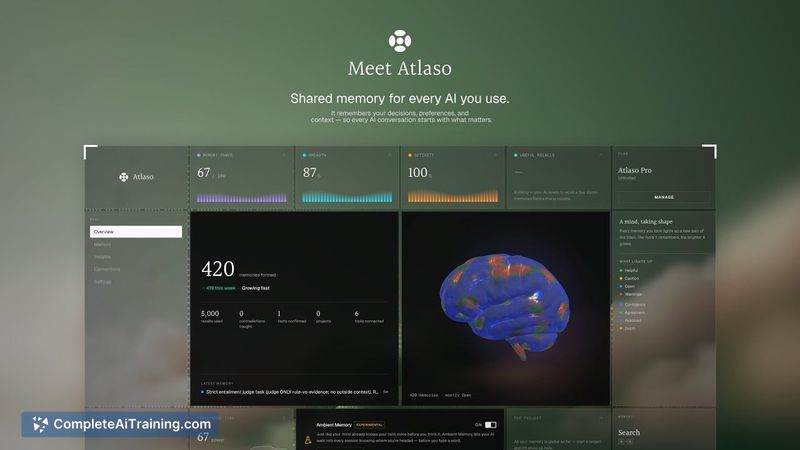
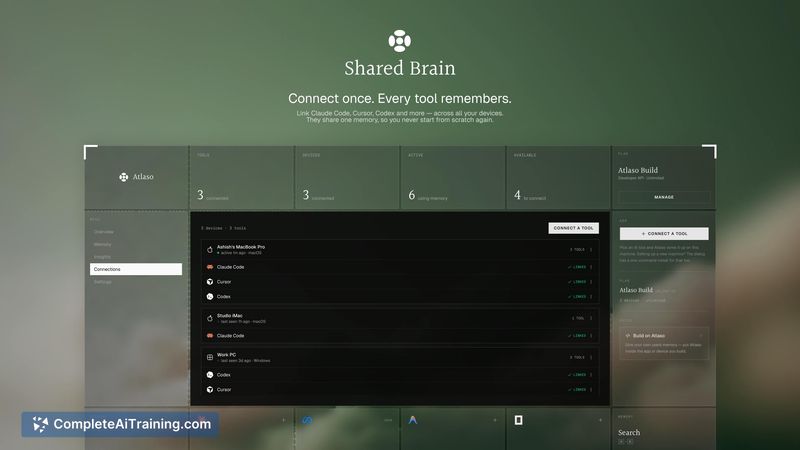
Atlaso launched this week as a solution to a specific problem: re-explaining context every time you switch AI tools. The founder, Ashish Khandelwal, built it after getting tired of telling Claude Code about a project, switching to Cursor, and starting over. It runs on original memory research and the team published their own benchmarks, including one they lost (LoCoMo by 11.5 points).
Key Features
- Cross-tool memory - Memory follows you across Claude Code, Cursor, Codex, OpenCode, Antigravity and Claude Desktop. Correct something in one tool and the corrected version appears in another.
- Ambient Memory - Before you type, Atlaso surfaces a short orientation from your own memory. The founder describes this as "giving AI a subconscious." It orients but does not invent facts.
- Per-project and global scoping - Each repo keeps its own memory, so two projects on the same stack don't see each other's conventions. Global memory stores things true about you rather than about the code.
- MCP server integration - Atlaso exposes an MCP server, so whichever tool you're already in can write memories directly. You can paste export data into Claude Code or Cursor and say "save each of these to my Atlaso memory."
- Automatic capture - The tool captures decisions and preferences out of sessions as you work. You don't file anything or call a recall tool.
Pricing and Value
Atlaso is free to start. A paid account allows up to 100 devices. The company states they do not read your memories or train anything on them, free or paid. API keys, tokens, private keys, passwords, and credentials in URLs are stripped on your machine before anything is sent. Pricing beyond the free tier is not yet fully defined in the available materials.
Pros
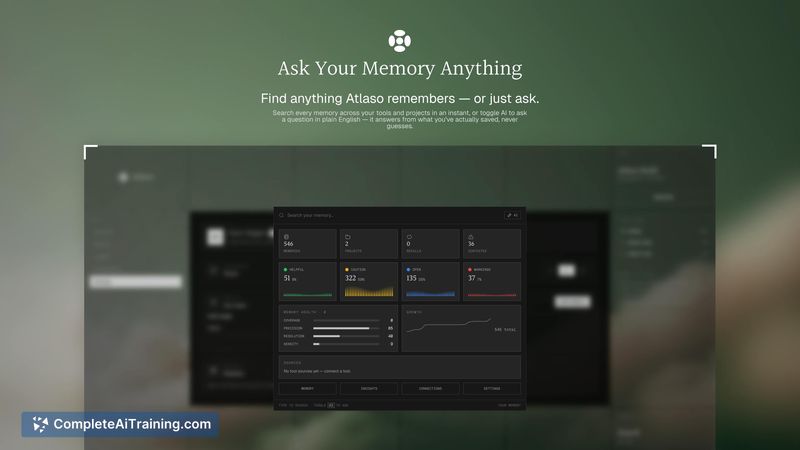
- Memory is selective retrieval, not the whole store - recall uses a top-k hybrid search (BM25 + embeddings, rank-fused), k=5, hard-capped at 50 server-side. The injected block is roughly 650 tokens at median memory length, measured against a real 934-memory store.
- Recalled notes go in as notes alongside the code the model still reads. The repo is checkable and a memory isn't, so what's actually in the files wins.
- Memory is scoped per project, so one repo's context doesn't bleed into another. Global memory only stores things that are true about you rather than about the code.
- Secrets never make it into memory - API keys, tokens, private keys, passwords, and credentials in URLs get stripped on your machine before anything is sent.
Cons
- When a memory is superseded, the old one stays live and looks identical to the new one. The engine has dispute/supersede semantics and honors them on read, but no shipped connector can write those edges yet. The correction path today requires explicitly forgetting the old one and re-saving.
- In Claude Code and Codex, the recalled block goes to the model, not your terminal. You cannot see what got injected, and removing a memory requires a trip to the dashboard rather than a keystroke.
- Atlaso is not well suited for teams. It is partitioned per user with no shared layer, no roles, and no attribution. A workaround using one account across multiple devices exists but is rate-limited per account and sized for one person.
Atlaso works best for individual developers who switch between multiple AI coding tools and want to stop re-explaining context. The tool is currently in its early days - the founder is transparent about gaps in the supersede logic and the lack of team features. If you work alone and use Claude Code, Cursor, Codex, or similar tools, Atlaso addresses a real friction point. If you need team memory, self-hosting, or the ability to see and kill individual recalled facts from your terminal, you may want to wait for future releases.
Jobs Atlaso suits
We checked Atlaso against 500+ jobs; these get the most out of it.
Alternatives to Atlaso
Other tools that do the same main job. Our AI compared Atlaso with similar tools and kept the ones you could use instead.