AI tool
Eggshell
Eggshell uses GPT-6 Astra to turn rough meeting notes into structured, ready-to-send client summaries. It is built for consultants and client-facing teams who need to produce accurate follow-ups quickly.
About Eggshell
Eggshell is an open-source developer tool written in Lean that stores AI agent work, results, and evidence in a local .egg graph file. It retrieves relevant memory from prior chats and hands it to a new session without calling an LLM to summarize or organize that memory. The tool is available as a Codex plugin, with separate experimental adapters for Claude Code, Gemini CLI, Cursor, and OpenCode.
Review
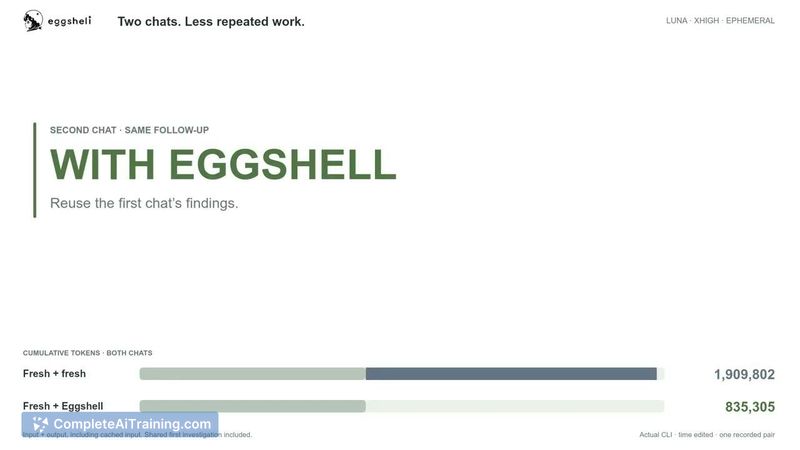
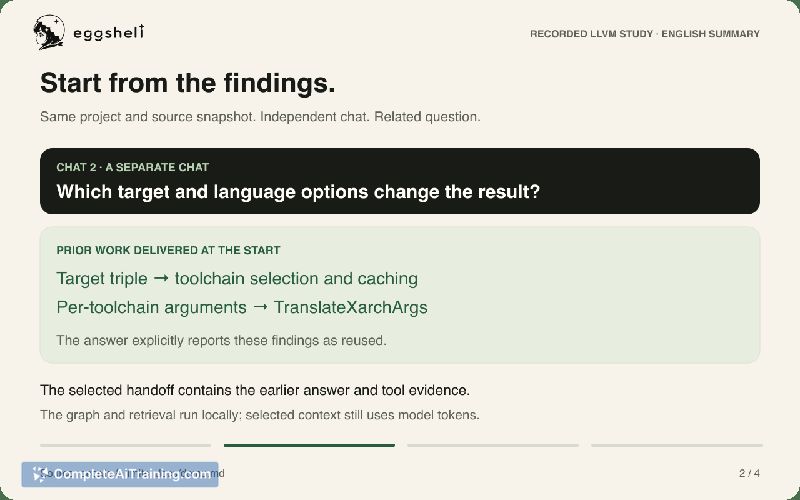
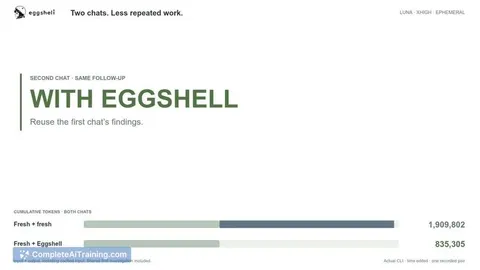
Eggshell tackles a specific friction point in AI-assisted coding: when you start a new chat, the agent often repeats investigation you already paid for in tokens. Instead of summarizing past work through an LLM, Eggshell records repository searches, tool outputs, and conclusions locally, then passes relevant prior work into the next chat. The result is a memory layer that operates entirely on your machine and lets you inspect exactly what context reached the agent.
Key Features
- Stores tool results, findings, and their evidence in a local .egg graph that persists across independent chat sessions.
- Retrieves relevant prior work and injects it into a new chat's context, with no LLM calls used to organize or summarize memory.
- Links equivalent pieces of work across chats and follows those relationships to surface reusable results while keeping unfinished work explicit.
- Runs storage, matching, and graph processing locally, so you can inspect what context was selected and why.
- Includes formal verification of key properties in Lean, such as preserving provenance and ensuring selected results come from the recorded graph.
Pricing and Value
Eggshell is free and open source. The code, installation instructions, and experimental evidence are published on GitHub. There are no paid tiers or usage limits described in the current documentation.
Pros
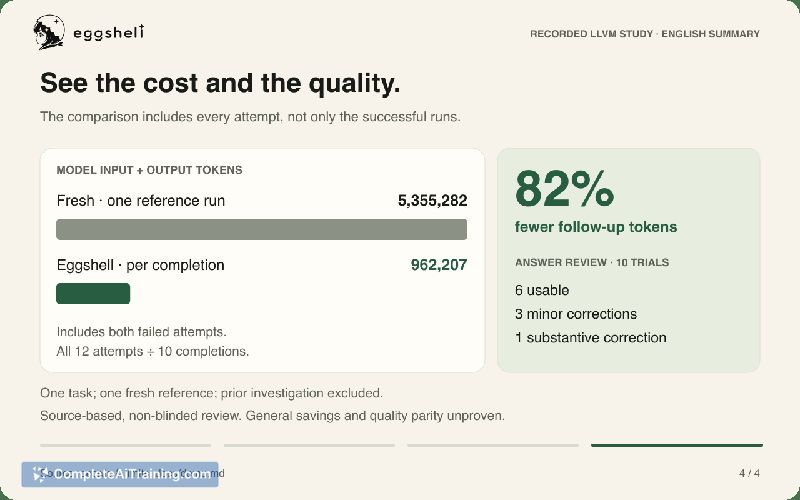
- Reduces repeated investigation across coding sessions, which can lower token consumption. A published LLVM follow-up experiment showed roughly 82% fewer input-plus-output tokens compared to a fresh-chat baseline, though this was a single-task measurement with existing prior work.
- Memory stays local, so no data leaves your machine for the memory layer itself. The context it hands to the agent still consumes normal model input tokens.
- Machine-checked proofs in Lean verify properties like provenance preservation, giving a formal guarantee about how results are traced.
- Works with multiple coding-agent environments through the Codex plugin and separate experimental adapters.
- Inspectable by design. You can examine the exact context passed to the agent and understand why specific items were selected.
Cons
- Setup currently requires working through a Codex plugin or experimental adapter, and the installation path may not be straightforward for developers who don't use those environments.
- The documented token savings come from a single workload with pre-existing prior work; the tool does not yet have a broad set of benchmarks across different project types or agent workflows.
- Eggshell is not well suited for users who rarely return to related work across coding sessions or who work on many short, unrelated tasks where cross-chat memory adds little value.
Eggshell fits developers who frequently open new AI coding chats on the same project and want to carry forward investigation results without paying for LLM-based summarization. It's less relevant for one-off tasks or projects where each session tackles something entirely new. The formal verification and local-only architecture make it worth a look if you want memory that you can audit directly, though you should expect to invest some time in setup and evaluate whether the token reduction holds for your own workflows.
Jobs Eggshell suits
We checked Eggshell against 500+ jobs; these get the most out of it.
Alternatives to Eggshell
Other tools that do the same main job. Our AI compared Eggshell with similar tools and kept the ones you could use instead.