MCP server · Research
Gibs MCP server
by buildsyncinc
Lets your AI answer AI Act, GDPR and DORA compliance questions with article-level legal citations.
Gibs is a helper that connects your AI assistant to a legal knowledge base covering three big European rules: the EU AI Act, GDPR and DORA. You ask a plain question about compliance, and your AI comes back with an answer that points to the exact articles. It is handy if you work with AI products, personal data or financial services and need to check the rules without reading hundreds of pages yourself.
What is an MCP server? The 30-second version
On its own, your AI can only chat with you using what it already learned. An MCP server is a small helper program that gives your AI a new skill or a connection to an outside service. This one connects your AI to the Gibs compliance knowledge base, which holds the text of the AI Act, GDPR and DORA. Once connected, your AI can look things up there and bring back answers with real article numbers instead of guessing.
What this MCP server does
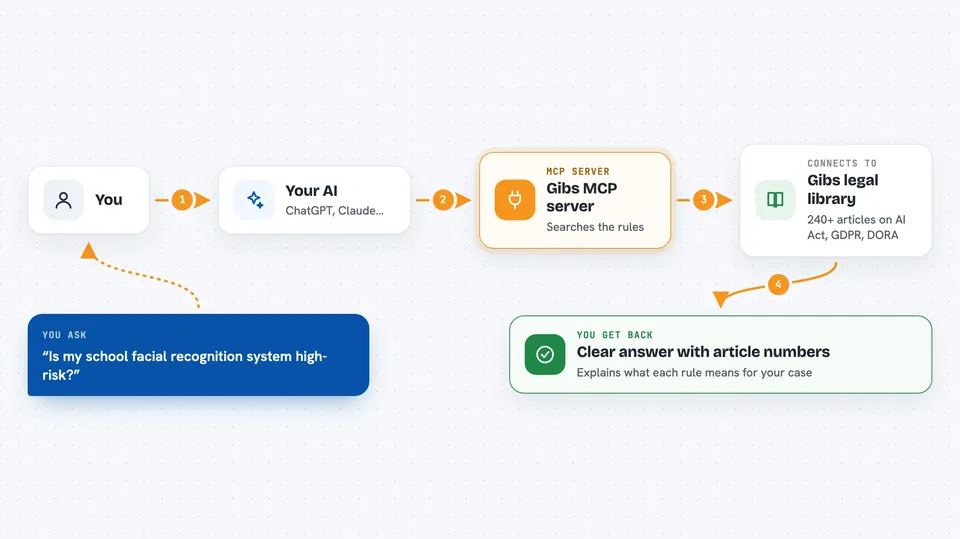
You type a question in your AI chat, like whether a certain system counts as high-risk or what a data breach rule says. Your AI sends that question to the Gibs helper, which searches its library of over 240 articles across the three regulations. The helper finds the relevant passages and sends them back. Your AI then writes you a clear answer with the article numbers and a short explanation of what each one means for your case.
 Click to zoom
What you can do with it
- Classify an AI system under AI Act risk levels (unacceptable, high-risk, limited, minimal)
- Ask any GDPR question and get the relevant articles back
- Check whether DORA applies to a company and which obligations follow
- Get a list of obligations that apply to a specific risk classification
- Look up exceptions and exemptions for a rule
- Check whether the compliance service is reachable
Try asking your AI
- “Classify my facial recognition attendance system for schools”
- “What are the GDPR requirements for a data breach notification?”
- “Does DORA apply to a fintech startup processing payments?”
- “What obligations apply to a high-risk AI system used in hiring?”
What it gives back to you
You get a written answer in the chat, usually a few paragraphs, with the specific article numbers cited (for example Article 33 or Annex III, point 1(a)). For classification questions you also get the risk level and a list of obligations that follow from it. For scope questions you get a yes or no with the reasoning. Nothing is changed anywhere; it only reads and explains.
Before you start
What you need
- An API key from gibs.dev (sign up on the site and copy it from your dashboard)
- An MCP-compatible app such as Claude Desktop, Claude Code or Cursor
Good to know
It gives you legal information with citations, not legal advice, so check anything important with a qualified lawyer before you rely on it.
Install it with your AI
Add Gibs MCP server to your AI, no technical skills needed
You don't install anything by hand. You copy one prompt, paste it into an AI that can work on your computer, and it checks, installs and connects the server for you, asking you when it needs something.
Sign in to get the install prompt
Members get a ready-made prompt that lets the Claude desktop app check Gibs MCP server, install it and connect it for them, step by step. You don't need any technical skills: you copy, paste and answer a few questions. Your connected AI can also find and install any of the 4,361 MCP servers here for you.
Who it's for
People who deal with AI products, personal data or financial rules at work, such as product managers, compliance officers and developers who need quick answers with legal citations.