MCP server · Research
OpenStreetMap MCP server
Lets your AI look up addresses, find nearby places, and plan routes using OpenStreetMap data.
This is a small helper that connects your AI assistant to OpenStreetMap, the free map of the world. Once it is set up, you can ask your AI things like where a place is, what is nearby, or how to get from one spot to another. It is handy for anyone who plans trips, checks out neighborhoods, or just wants map answers in plain chat.
What is an MCP server? The 30-second version
On its own, your AI can only chat with you using what it already learned. An MCP server is a small helper program that gives your AI a new skill or a connection to another service. This one connects your AI to OpenStreetMap, so when you ask a location question, the AI can actually look it up on the map instead of guessing. You do not need to know how it works under the hood. You just ask, and the AI uses this helper behind the scenes.
What this MCP server does
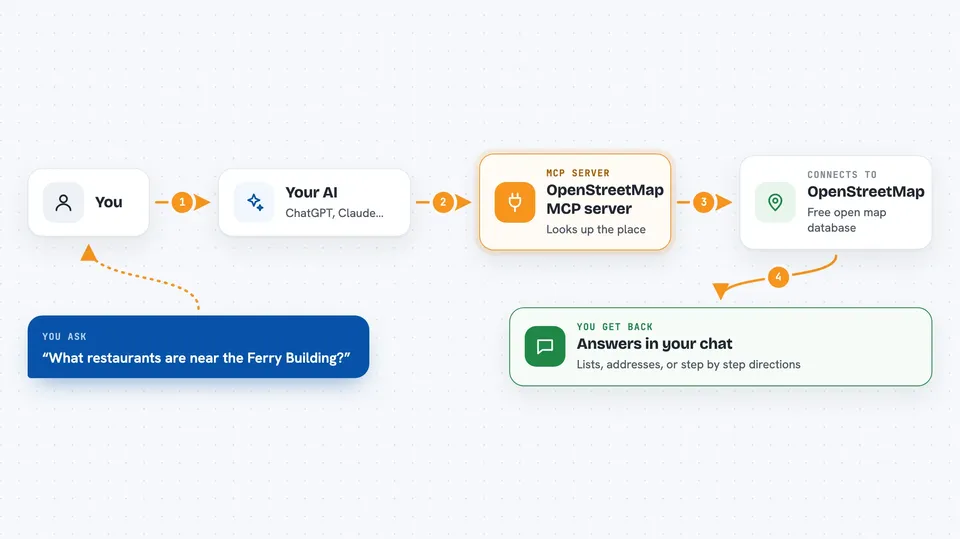
You ask your AI a location question in normal words, like where a place is or what is near it. The AI passes that request to this helper program running on your computer. The helper talks to OpenStreetMap, which is a free, open map database, and looks up the answer. Then the AI shows you the result in the chat, as a list, a short summary, or step by step directions. You never have to open a map website yourself.
 Click to zoom
What you can do with it
- Turn an address or place name into map coordinates
- Turn coordinates back into a readable address
- Find nearby points of interest like restaurants or shops
- Get route directions between two places
- Suggest a fair meeting point for several people
- Find schools, EV charging stations, or parking near a spot
- Compare commute options between home and work
Try asking your AI
- “Where is 1600 Amphitheatre Parkway in map coordinates?”
- “What restaurants are near the Ferry Building in San Francisco?”
- “Give me driving directions from downtown Oakland to San Jose airport.”
- “Find a good meeting point for people coming from Berkeley, San Mateo, and Fremont.”
What it gives back to you
You get answers back in the chat as text. That might be a list of places with short descriptions, a pair of coordinates, a readable address, or turn by turn directions. For bigger questions like exploring a neighborhood, you get a summary of what is around. It does not change anything on the map. It only reads and reports.
Before you start
What you need
- The Claude desktop app or another app that supports MCP servers
- uv installed on your computer (a small tool that runs Python programs; the install page explains it)
Good to know
The map data comes from OpenStreetMap volunteers, so details like opening hours or parking fees can be out of date or incomplete. Double check anything important before you rely on it.
Install it with your AI
Add OpenStreetMap MCP server to your AI, no technical skills needed
You don't install anything by hand. You copy one prompt, paste it into an AI that can work on your computer, and it checks, installs and connects the server for you, asking you when it needs something.
Sign in to get the install prompt
Members get a ready-made prompt that lets the Claude desktop app check OpenStreetMap MCP server, install it and connect it for them, step by step. You don't need any technical skills: you copy, paste and answer a few questions. Your connected AI can also find and install any of the 4,361 MCP servers here for you.
Who it's for
Anyone who plans trips, checks out neighborhoods, or needs quick map answers, like travelers, real estate shoppers, and commuters.