
MCP server · Developer tools
Azure DevOps MCP server
Let your AI read and update your Azure DevOps projects, work items, repos and pipelines for you.
This is a small helper that connects your AI assistant to Azure DevOps, the place where many teams keep their code, tasks and build pipelines. Once it is set up, you can ask your AI in plain words to look things up or make changes there, instead of clicking around the website. It is handy for anyone who works in Azure DevOps every day, even if you are not a developer.
What is an MCP server? The 30-second version
On its own, your AI can only chat. It cannot see your work tools. An MCP server is a small helper program that gives your AI a new skill, in this case a connection to Azure DevOps. You add this helper to your AI app, tell it your Azure DevOps address and a password-like token, and from then on your AI can look things up and do things in Azure DevOps when you ask.
What this MCP server does
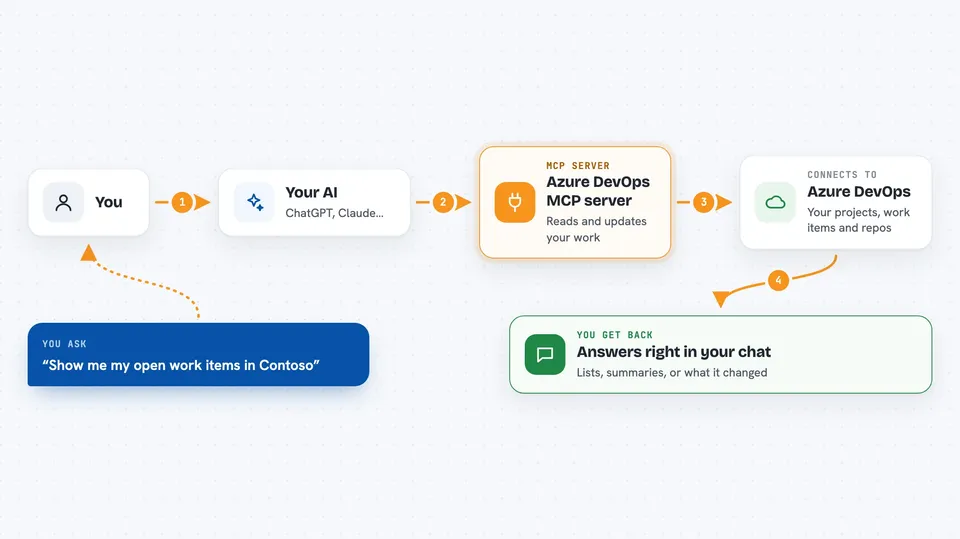
You type a request in your AI chat, like asking for your open work items or the latest pipeline run. Your AI passes that request to this helper program. The helper talks to Azure DevOps using your account details, fetches or changes what you asked for, and hands the result back to your AI. Your AI then shows it to you in the chat as a list, a summary or a short confirmation. It works both ways: it can read things and also create or update them, like a new work item or a branch.
 Click to zoom
What you can do with it
- List your projects, repositories and pipelines
- Look up and search work items, code and wiki pages
- Create and update work items and attach files to them
- Create branches and commits in a repository
- Create and review pull requests, and add comments
- Check pipeline runs, logs and stage timelines
- Trigger a pipeline run with your own settings
Try asking your AI
- “Show me my open work items in the Contoso project”
- “What did the last run of the nightly build pipeline do?”
- “Create a bug work item called Login page crashes on mobile”
- “List the open pull requests in the web-app repository”
What it gives back to you
You get answers right in the chat: lists of work items, repositories or pipeline runs, short summaries of a pull request or a build, and file or log content when you ask for it. When you ask it to change something, it tells you what it created or updated, like the ID of a new work item. It can also download a pipeline artifact file as text for you to read.
Before you start
What you need
- An Azure DevOps account with access to your organization
- Your organization URL, like https://dev.azure.com/your-organization
- A Personal Access Token from Azure DevOps (a kind of password for apps; Azure DevOps lets you create one in your user settings)
- Node.js version 16 or newer on your computer
Good to know
This helper can change things in Azure DevOps, like creating work items, branches and pull requests, so check what your AI is about to do before you say yes.
Install it with your AI
Add Azure DevOps MCP server to your AI, no technical skills needed
You don't install anything by hand. You copy one prompt, paste it into an AI that can work on your computer, and it checks, installs and connects the server for you, asking you when it needs something.
Sign in to get the install prompt
Members get a ready-made prompt that lets the Claude desktop app check Azure DevOps MCP server, install it and connect it for them, step by step. You don't need any technical skills: you copy, paste and answer a few questions. Your connected AI can also find and install any of the 4,609 MCP servers here for you.
Who it's for
Anyone who uses Azure DevOps at work, like project managers, testers, support staff and developers who want to check or update things without clicking through the website.


