MCP server · Notes
Tessera MCP server
Your AI gets a local memory that keeps notes and searches your documents across sessions.

Tessera is a memory helper that runs on your own computer. It lets your AI remember things you tell it and search through your files, so you do not have to repeat yourself every time you start a new chat. It is handy for anyone who works with Claude Desktop and wants their notes, decisions and documents to stay available.
What is an MCP server? The 30-second version
On its own, your AI can only chat with you in the moment. An MCP server is a small helper program that gives your AI a new skill or a connection to something outside the chat. Tessera is that helper here: it runs quietly on your machine and gives your AI a memory plus a search box for your files. When you ask your AI something, it can reach into Tessera to look things up or save a note for later.
What this MCP server does
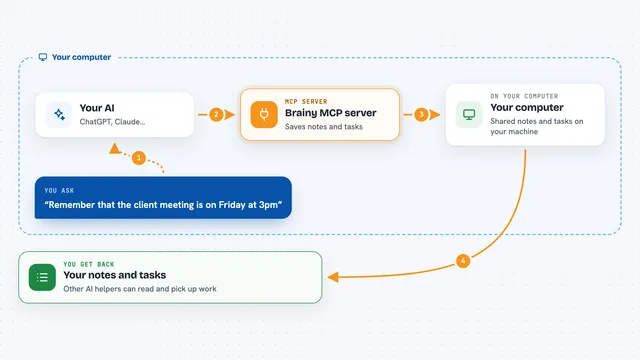
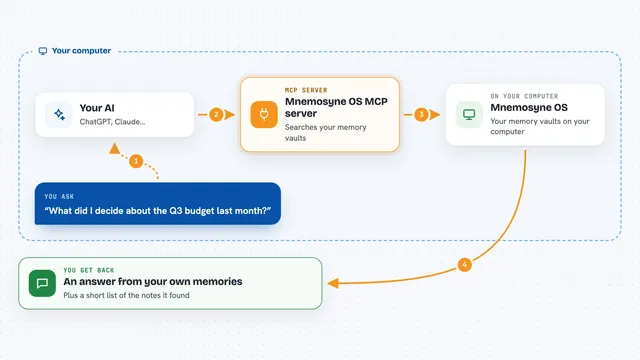
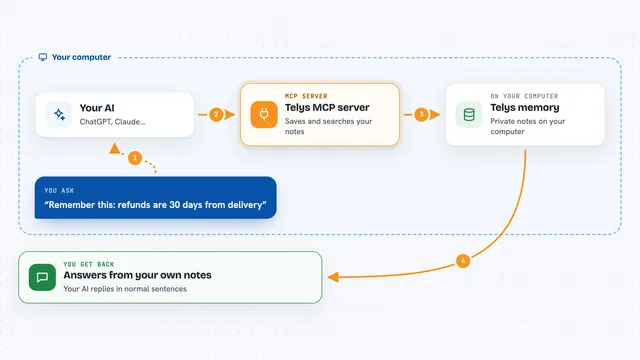
You ask your AI a question, like what you decided about a project last month. Your AI passes that question to Tessera, which searches through the documents and memories you have saved on your computer. Tessera looks at both the meaning of your words and the exact keywords, then hands back the best matches with a confidence label. Your AI reads those results and answers you in the chat. When you tell your AI something worth keeping, Tessera saves it as a memory so it is there next time.
 Click to zoom
What you can do with it
- Save decisions, preferences and facts so they survive across chat sessions
- Search your Markdown, CSV, code and other files by meaning, not just exact words
- Recall past memories filtered by date, tag or category
- Spot contradictions between an old memory and a newer one
- See a diagram of how your documents relate to each other
- Export your memories as JSON or an Obsidian-style vault
- Review what Tessera learned automatically from your conversations
What it gives back to you
You get answers in the chat, built from the documents and memories Tessera found. It also shows confidence labels like confident match or possible match, so you know how sure it is. For some requests you get lists, tables from spreadsheets, or a diagram of related documents. When you save a memory, Tessera confirms it stored it and may note if it looks similar to something you already saved.
Before you start
What you need
- Python installed on your computer
- The Claude desktop app if you want to use it through Claude
- About 220 MB of free space for the embedding model it downloads the first time
Good to know
Tessera can delete memories and reads the files you point it at, so be careful about which folders you index and about running forget commands.
Install it with your AI
Add Tessera MCP server to your AI, no technical skills needed
You don't install anything by hand. You copy one prompt, paste it into an AI that can work on your computer, and it checks, installs and connects the server for you, asking you when it needs something.
Sign in to get the install prompt
Members get a ready-made prompt that lets the Claude desktop app check Tessera MCP server, install it and connect it for them, step by step. You don't need any technical skills: you copy, paste and answer a few questions. Your connected AI can also find and install any of the 4,361 MCP servers here for you.
Who it's for
People who use Claude Desktop for ongoing projects and want their notes, decisions and documents to stay searchable between sessions.