MCP server · Research
BioMCP biomedical research server
Lets your AI look up genes, variants, drugs, diseases and clinical trials from trusted medical sources.
BioMCP is a helper that connects your AI to trusted biomedical research sources like PubMed, ClinicalTrials.gov and MyVariant.info. Instead of you opening five different websites and copying things into a document, you ask your AI a question and it pulls the facts back for you. It is handy for anyone who reads medical or biology research as part of their day.
What is an MCP server? The 30-second version
On its own, your AI can only chat with you using what it already learned. An MCP server is a small helper program that gives your AI a new skill, in this case a connection to biomedical databases. Once BioMCP is connected, your AI can ask it about a gene, a variant, a drug, a disease or a clinical trial, and BioMCP goes and fetches the answer from the real source. You just ask your question in normal words, and the AI does the looking up for you.
What this MCP server does
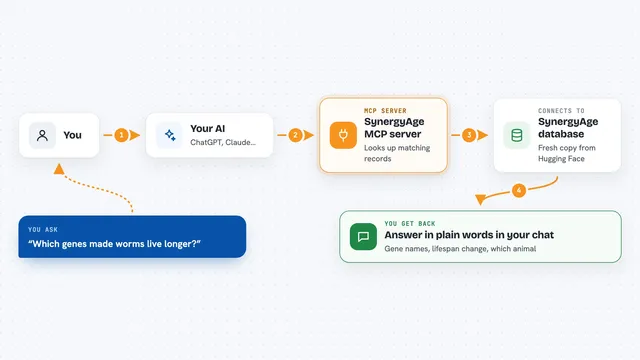
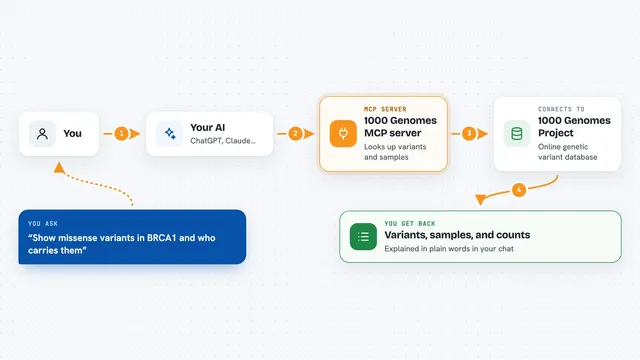
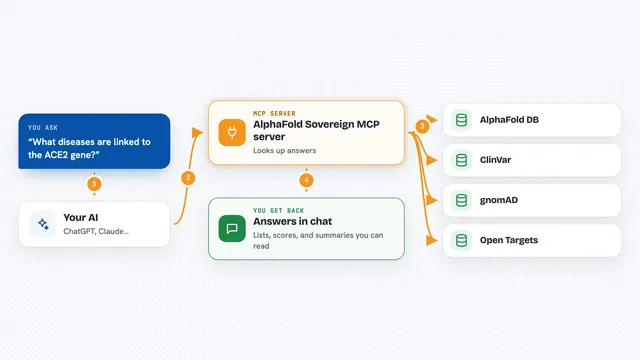
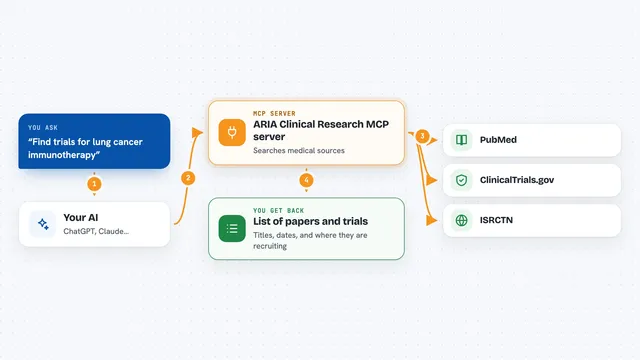
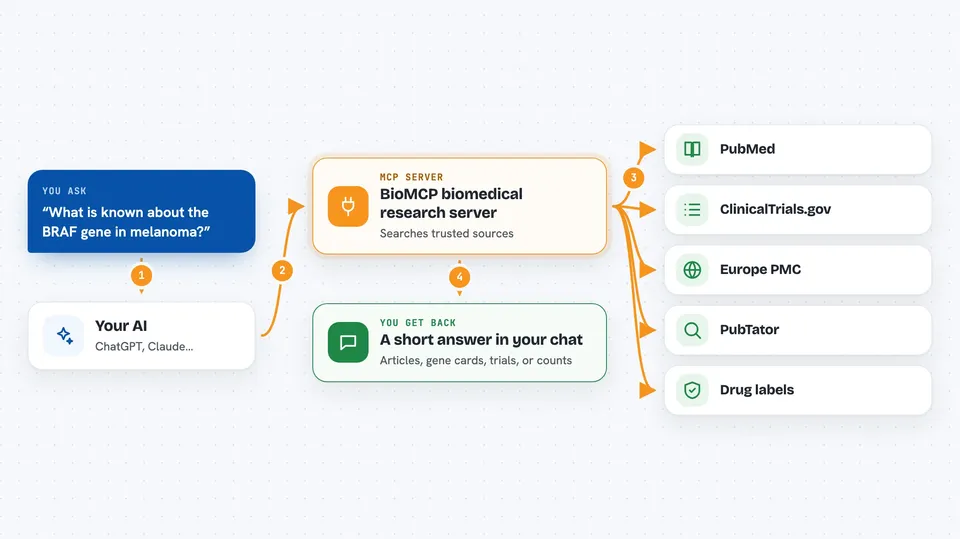
You ask your AI something like what is known about the BRAF gene in melanoma. The AI passes that request to BioMCP, which is running quietly in the background. BioMCP then queries the right biomedical sources, such as PubMed for articles or ClinicalTrials.gov for trials. It tidies up the results, removes duplicates and hands back a compact answer. Your AI shows you that answer in the chat, and you can ask follow-up questions from there.
 Click to zoom
What you can do with it
- Search medical articles across PubMed, Europe PMC and PubTator
- Look up details about a gene, variant, drug, disease or protein
- Find clinical trials for a condition or a specific drug
- Pivot from a gene to its pathways, drugs or related trials
- Check what a paper cites, who cites it, and what entities it mentions
- Look up drug labels, approvals and reported side effects
- Run gene-set enrichment on a list of genes
Try asking your AI
- “What is known about the BRAF V600E variant and which drugs target it?”
- “Find recruiting clinical trials for melanoma in the United States.”
- “Give me a summary of recent articles about Lynch syndrome.”
- “What pathways is the BRCA1 gene involved in?”
What it gives back to you
You get back short, structured answers in the chat: lists of articles with titles and identifiers, gene or drug summary cards, trial details, or counts across several sources. You can ask for more detail on any one item, like the pathways for a gene or the eligibility rules for a trial. Some answers include small charts when you are working with study data. Everything appears as normal text in your conversation, so you can copy it into a report or email.
Before you start
What you need
- The biomcp program installed on your computer (the README shows a one-line install command)
- A compatible AI app such as Claude Desktop, Claude Code or Codex
- Optional API keys for some sources, which you can skip at first
Good to know
The biomedical sources have their own terms of use, and some restrict commercial or clinical use, so check each source's licence before relying on the data.
Install it with your AI
Add BioMCP biomedical research server to your AI, no technical skills needed
You don't install anything by hand. You copy one prompt, paste it into an AI that can work on your computer, and it checks, installs and connects the server for you, asking you when it needs something.
Sign in to get the install prompt
Members get a ready-made prompt that lets the Claude desktop app check BioMCP biomedical research server, install it and connect it for them, step by step. You don't need any technical skills: you copy, paste and answer a few questions. Your connected AI can also find and install any of the 4,361 MCP servers here for you.
Who it's for
Researchers, clinicians, students and anyone in life sciences or healthcare who reads biomedical literature or trial information regularly.