
MCP server · Research
TinySearch MCP server
by MarcellM01
Let your AI search the web, read the best pages, and bring back short quoted evidence with source links.
TinySearch is a small helper that lets your AI search the web and read pages for you, then hand back only the useful bits with their source links. It runs on your own computer, so you do not need a paid search service. It is handy if you often ask your AI about things that happened recently or that it does not already know.
What is an MCP server? The 30-second version
On its own, your AI can only chat with what it already learned during training. An MCP server is a small helper program that gives your AI a new skill or a connection to an app or service. This one connects your AI to the web, so it can search and read pages when you ask. You install it once, and after that your AI can use it whenever a question needs fresh information.
What this MCP server does
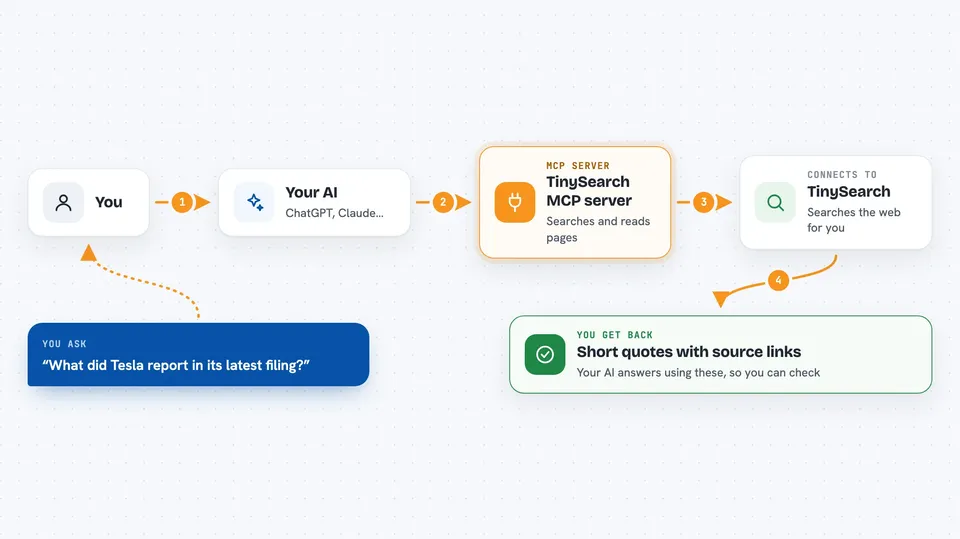
You ask your AI a question that needs the web. Your AI sends the question to TinySearch, which searches for pages and reads the most promising ones. TinySearch then picks out the passages that actually answer your question and drops the rest, like menus and ads. It hands those passages back to your AI together with the page links. Your AI then writes its answer using that evidence, so you can check where it came from.
 Click to zoom
What you can do with it
- Search the web for a topic and get a short list of results
- Read one to five specific pages you point it at and pull out the useful parts
- Keep only the passages that matter, so your AI does not have to read whole pages
- Return every passage with the page link it came from, so you can verify it
- Open pages that need clicking or scrolling before the content appears
- Check the current date and time when a question depends on it
Try asking your AI
- “What did Tesla report in its latest Form 8-K filing?”
- “Find recent news about the new EU AI rules and summarize the key points with links”
- “Read this page and tell me what it says about refunds: https://example.com/help/refunds”
- “What is today's date, and what are the latest headlines about electric cars?”
What it gives back to you
You get short quoted passages from real pages, each with its source link, plus a list of related links it noticed. Your AI then writes its answer using those passages, so the reply in your chat is grounded in pages you can open yourself. If a search finds nothing, it tells you that clearly instead of making something up.
Before you start
What you need
- uv installed on your computer (a small free tool that runs Python programs; the TinySearch page links to it)
- An MCP client such as Claude Desktop or another app that supports MCP servers
Good to know
It reads public web pages on your behalf, so treat anything it brings back as unverified until you open the source links yourself.
Install it with your AI
Add TinySearch MCP server to your AI, no technical skills needed
You don't install anything by hand. You copy one prompt, paste it into an AI that can work on your computer, and it checks, installs and connects the server for you, asking you when it needs something.
Sign in to get the install prompt
Members get a ready-made prompt that lets the Claude desktop app check TinySearch MCP server, install it and connect it for them, step by step. You don't need any technical skills: you copy, paste and answer a few questions. Your connected AI can also find and install any of the 4,609 MCP servers here for you.
Who it's for
Anyone who asks their AI about recent events, prices, news, or company filings and wants answers with real source links, especially researchers, analysts, and writers.


