MCP server · Productivity
Jira MCP server
Let your AI look up, create, and update Jira issues, sprints, and comments for you.
This is a helper that connects your AI assistant to Jira, the tool many teams use to track tasks, bugs, and sprints. Once it is set up, you can ask your AI things like what is in the current sprint or what is assigned to you, and it will go and check Jira for you. It is handy for anyone who spends part of their day in Jira and would rather just ask a question than click around.
What is an MCP server? The 30-second version
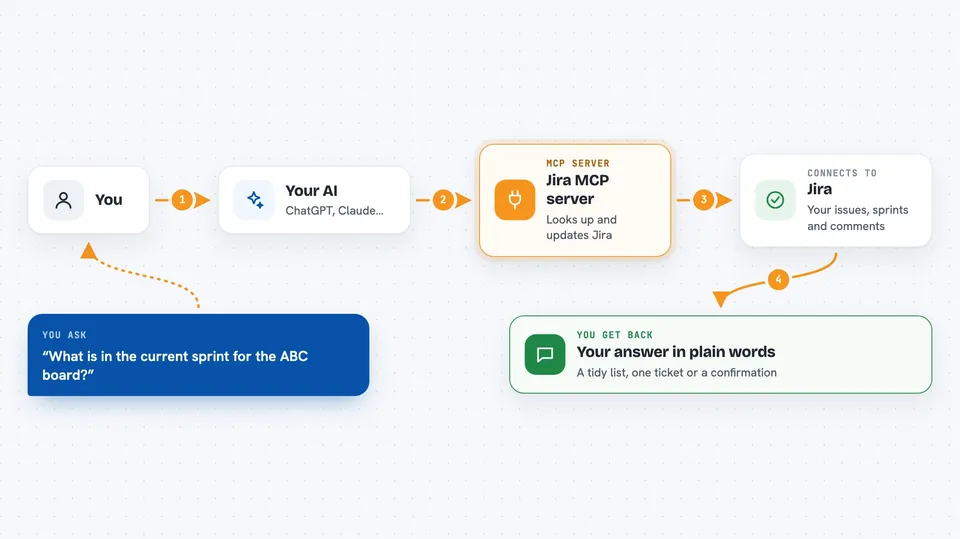
On its own, your AI can only chat with you using what it already knows. An MCP server is a small helper program that gives your AI a new skill or a connection to another app. This one connects your AI to your Jira account, so it can look things up and make changes there when you ask. You stay in the chat, and the helper does the Jira work behind the scenes.
What this MCP server does
You ask your AI a question about your Jira work, like what is in the current sprint or what a certain ticket says. The AI passes that request to this helper, which talks to your Jira account using your login details. The helper brings back the answer, a list, or a confirmation that something was changed. You see the result right in the chat, in normal words. If you asked it to create or update something, it tells you what it did.
 Click to zoom
What you can do with it
- Look up any issue by its key and see its status, assignee, and description
- Search issues with JQL, Jira's search language, using plain questions
- Create new issues, sub-tasks, or bugs in a project
- Update an existing issue's details
- List the active and future sprints for a board
- Move an issue to a new status in its workflow
- Add or read comments on an issue
- Log time spent on an issue
Try asking your AI
- “Show me all issues assigned to me that are still in progress”
- “What is in the current sprint for the ABC board?”
- “Create a bug in project ABC: Login fails on Safari”
- “Add a comment to PROJ-123 saying the fix is ready for review”
- “How much time has been logged on PROJ-456?”
What it gives back to you
You get back plain answers in the chat, like a list of issues with their keys and statuses, or the details of one ticket. When you ask it to create or change something, it confirms what it did and often gives you the issue key or a link. Searches come back as a tidy list you can read or ask follow-up questions about. Comments and history come back as text you can scroll through.
Before you start
What you need
- A Jira account (Atlassian cloud)
- Your Jira web address, like https://your-company.atlassian.net
- Your Atlassian email address
- An Atlassian API token, which is a kind of password for apps that you create for free on the Atlassian website
Good to know
This helper can create and change things in your Jira account, so only ask it to do what you would be comfortable doing yourself, and check the confirmation it gives you.
Install it with your AI
Add Jira MCP server to your AI, no technical skills needed
You don't install anything by hand. You copy one prompt, paste it into an AI that can work on your computer, and it checks, installs and connects the server for you, asking you when it needs something.
Sign in to get the install prompt
Members get a ready-made prompt that lets the Claude desktop app check Jira MCP server, install it and connect it for them, step by step. You don't need any technical skills: you copy, paste and answer a few questions. Your connected AI can also find and install any of the 4,361 MCP servers here for you.
Who it's for
Anyone who works in Jira day to day, like developers, QA testers, project managers, and team leads who want to ask questions instead of clicking around.