MCP server · Developer tools
DevUtils MCP server
by paladini
Give your AI a toolbox of 36 everyday developer utilities, from hashing to JSON formatting.

DevUtils MCP Server is a small helper that gives your AI assistant a set of 36 everyday developer tools. It handles things like hashing text, encoding and decoding data, generating IDs and passwords, decoding tokens, formatting JSON, and converting timestamps. It is handy for anyone who works with code, data, or technical text and wants their AI to do these small jobs reliably instead of guessing.
What is an MCP server? The 30-second version
On its own, your AI can only chat. An MCP server is a small helper program that gives your AI a new skill or a connection to a service. This one gives your AI a toolbox of developer utilities that run right on your computer. When you ask for a hash, an encoded string, or a formatted JSON, the AI uses this helper to do the work and hands you the result.
What this MCP server does
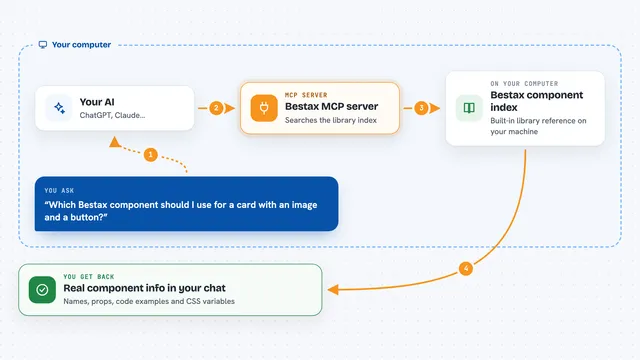
You ask your AI for something like a hash, a UUID, or a decoded token. The AI passes your request to this helper program running on your machine. The helper does the calculation locally, with no internet calls. Then it sends the answer back, and the AI shows it to you in the chat. Everything stays on your computer.
 Click to zoom
What you can do with it
- Generate MD5, SHA-1, SHA-256, SHA-512, and bcrypt hashes
- Encode and decode Base64, URL, HTML, and hex
- Create UUIDs, NanoIDs, passwords, and random hex strings
- Decode and validate JWT tokens
- Format, validate, and query JSON
- Convert timestamps, number bases, colors, and byte units
- Calculate CIDR ranges and validate IP addresses
- Analyze text, convert case, slugify, test regex, and diff texts
Try asking your AI
- “Generate a SHA-256 hash of this string: hello world”
- “Decode this JWT and show me the payload with readable dates”
- “Format this JSON nicely and tell me if it is valid”
- “What is the network and host range for 192.168.1.0/24”
What it gives back to you
You get back plain answers in the chat: a hash string, a decoded token with readable dates, a formatted JSON block, a list of network details, or a count of words and characters. For generators, you get the new ID or password. For diffs, you get a line-by-line comparison. Everything is shown as text you can copy.
Before you start
What you need
- Node.js 18 or newer (Node 22 recommended)
- An MCP-compatible AI client like Claude Desktop, Cursor, VS Code, or Windsurf
Good to know
It runs locally and does not call the internet, but it can generate passwords and hashes, so treat the output as sensitive if you paste it elsewhere.
Install it with your AI
Add DevUtils MCP server to your AI, no technical skills needed
You don't install anything by hand. You copy one prompt, paste it into an AI that can work on your computer, and it checks, installs and connects the server for you, asking you when it needs something.
Sign in to get the install prompt
Members get a ready-made prompt that lets the Claude desktop app check DevUtils MCP server, install it and connect it for them, step by step. You don't need any technical skills: you copy, paste and answer a few questions. Your connected AI can also find and install any of the 4,609 MCP servers here for you.
Who it's for
Developers, testers, and anyone who regularly works with code, tokens, encodings, or technical text and wants their AI to handle small utility tasks reliably.