MCP server · Video editing
proofcut MCP server
by tydude001
Lets your AI cut, caption, score and check a video on your own computer, from your recordings.

proofcut is a video editor that runs on your own computer and can be driven by an AI assistant. You give it your recordings, and it can cut out the retakes, add footage under the right lines, add music and captions, and render a finished film. It is handy if you make narrated videos like tutorials, demos or talks and want help with the slow, fiddly parts.
What is an MCP server? The 30-second version
On its own, your AI can only chat with you. An MCP server is a small helper program that gives your AI a new skill, in this case the ability to work with video on your machine. Once this helper is connected, your AI can ask proofcut to import your recordings, cut words out of the transcript, add footage, and render the film. You just describe what you want, and the AI uses proofcut to do it.
What this MCP server does
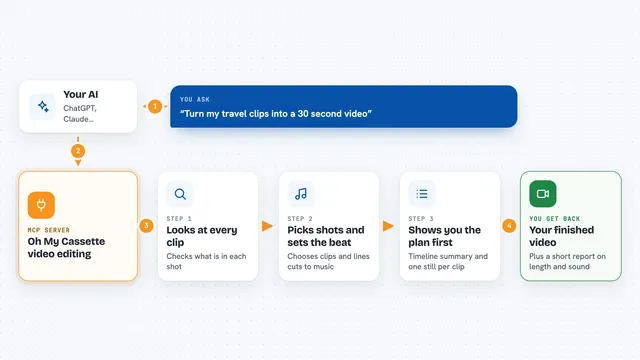
You tell your AI what kind of film you want and which recordings to use. The AI then calls proofcut to bring in your voiceover and footage and write down what was said. It can cut out retakes by naming the words to remove, place b-roll under the lines they belong to, add music and captions, and render the film on your computer. Finally, proofcut can check the finished file by listening to it again and telling you if it says what the edit says.
 Click to zoom
What you can do with it
- Cut out retakes and mistakes by naming the words to remove
- Attach b-roll footage to the phrases it belongs under
- Add music under the voice and set the loudness
- Burn captions into the video with your own spellings
- Render a finished film on your own machine
- Check the rendered file against the edit and report differences
- Export a project file to finish in another editor
Try asking your AI
- “Import my voiceover from recording.mp4 and transcribe it”
- “Cut out the retake where I say let me try that again”
- “Put the clip of the beach under the line about holidays”
- “Render the film and check that it says what the edit says”
What it gives back to you
You get answers in the chat, like a list of words that were cut or a report of what the render heard compared to the edit. It can also give you a finished video file on your computer. When it checks a render, it shows you the words that differ between the edit and the file. You might also see a grid image of your footage so the AI can look at what it placed.
Before you start
What you need
- A computer running Linux, macOS or Windows
- uv installed (a tool that runs Python programs; the README shows how)
- Your own video and audio recordings
- An AI assistant that can use MCP servers, like Claude Code
Good to know
This tool can change and delete parts of your video project, so it is a good idea to keep backups of your original recordings.
Install it with your AI
Add proofcut MCP server to your AI, no technical skills needed
You don't install anything by hand. You copy one prompt, paste it into an AI that can work on your computer, and it checks, installs and connects the server for you, asking you when it needs something.
Sign in to get the install prompt
Members get a ready-made prompt that lets the Claude desktop app check proofcut MCP server, install it and connect it for them, step by step. You don't need any technical skills: you copy, paste and answer a few questions. Your connected AI can also find and install any of the 4,609 MCP servers here for you.
Who it's for
People who make narrated videos, like tutorial creators, demo makers and anyone who records their screen and voice.