
MCP server · Research
Web Researcher MCP server
by zoharbabin
Lets your AI search trusted sites, read full articles, and give you real, clickable sources.
This is a helper that plugs into your AI assistant and turns it into a careful researcher. Instead of guessing or making up links, your AI searches the web, reads whole pages, and hands back sources you can actually open. It is handy for anyone whose work gets checked, like analysts, students, journalists, and lawyers.
What is an MCP server? The 30-second version
On its own, your AI can only chat with you using what it already learned. An MCP server is a small helper program that gives your AI a new skill or a connection to a service. This one connects your AI to web search and to places like academic paper databases, patent offices, and US court records. Once it is connected, you just ask in normal words and the AI uses this helper behind the scenes to look things up for you.
What this MCP server does
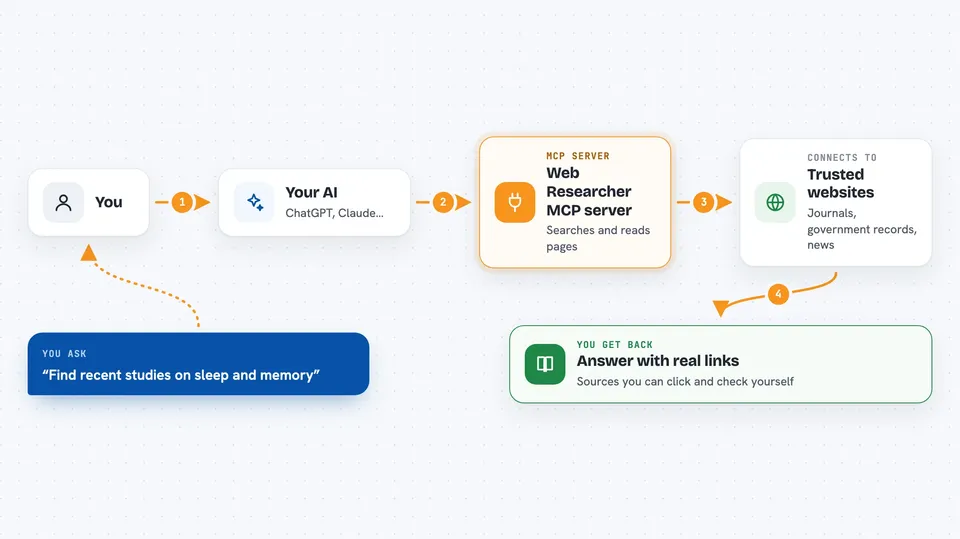
You ask your AI a question, like finding recent studies on a topic. The AI sends that request to this helper program running on your computer. The helper searches the web or a specific trusted source, then reads the full pages or documents it finds. It hands the results back to your AI, which writes you an answer with real links and proper citations. You can also tell it to only look at sites you trust, like medical journals or government records.
 Click to zoom
What you can do with it
- Search the web and get real, working links
- Read a full web page, PDF, Word file, or YouTube transcript
- Find academic papers with real authors, DOIs, and citation counts
- Look up patents from US, European, and international offices
- Search US public company filings and court records
- Check whether a citation is real or has been retracted
- Run a multi-step research session and export it as a report
What it gives back to you
You get back a written answer with a list of sources, each with a title, a link, and a formatted citation in styles like APA or MLA. For some tools you also get structured details, like paper authors and citation counts, or company filing numbers. Everything appears right in your chat, so you can click the links and check the sources yourself. Research sessions can also be saved and exported as a report.
Before you start
What you need
- A supported AI assistant, like Claude, Claude Desktop, or Cursor
- uv installed (a small free tool that runs the helper; the README shows a one-line install)
- Optional API keys for richer search providers, like Brave or Serper (a kind of password for apps; the site gives you one)
- An email address for SEC filing search, if you want that feature
Good to know
It runs on your own machine and keeps your searches private, but it does read web pages and can save snapshots to the Internet Archive, so avoid pointing it at private or sensitive pages you would not want copied.
Install it with your AI
Add Web Researcher MCP server to your AI, no technical skills needed
You don't install anything by hand. You copy one prompt, paste it into an AI that can work on your computer, and it checks, installs and connects the server for you, asking you when it needs something.
Sign in to get the install prompt
Members get a ready-made prompt that lets the Claude desktop app check Web Researcher MCP server, install it and connect it for them, step by step. You don't need any technical skills: you copy, paste and answer a few questions. Your connected AI can also find and install any of the 4,361 MCP servers here for you.
Who it's for
People whose research gets checked or cited, like analysts, students, journalists, lawyers, and medical researchers.


