MCP server · Notes
Fidelis Memory MCP server
Give your AI a local memory that saves your notes and brings back the exact wording later.

Fidelis Memory is a small helper that gives your AI a memory of your own notes, kept on your computer. It saves text and Markdown files you point it at, and later brings back the original passage instead of a rewritten summary. It is handy if you work with an AI assistant across many sessions and keep losing the details that mattered.
What is an MCP server? The 30-second version
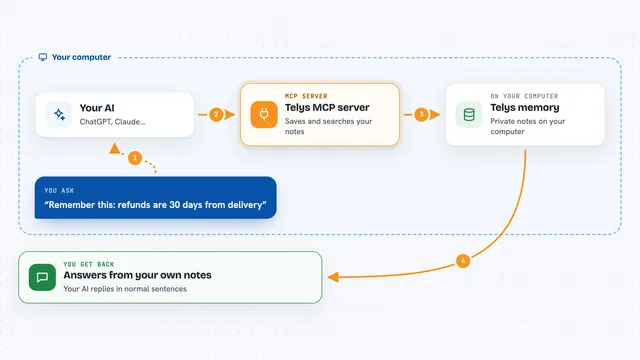
On its own, your AI can only chat with you in the moment and forgets everything when the session ends. An MCP server is a small helper program that gives your AI a new skill or a connection to something outside the chat. Fidelis Memory is that helper here: it connects your AI to a local store of your notes. When you ask about something you saved earlier, the AI calls Fidelis, Fidelis looks it up, and the AI shows you the text.
What this MCP server does
You point Fidelis at a folder of notes, and it saves the wording of those files into a local store on your machine. Later, in your AI chat, you ask a question about something you wrote before. The AI calls Fidelis, which searches the store and returns the matching passages. You see the original text in the chat, not a rewritten answer. You can also ask the AI to store a new note, correct an old one, or check that the memory is healthy.
 Click to zoom
What you can do with it
- Save notes and Markdown files from a folder into a local memory
- Recall the exact wording of a passage you saved earlier
- Search your memory with keywords and meaning together
- Store a new note directly from the chat
- Correct an earlier note without erasing the old version
- Check the health of the memory store
- Fetch a specific record by its identifier
Try asking your AI
- “Use Fidelis to find my Atlas billing migration note. What must happen before we retry? Quote the relevant text.”
- “Save this as a note in Fidelis: the vendor contract renews on 14 March, ask legal two weeks before.”
- “Search my Fidelis memory for anything I wrote about the onboarding checklist.”
- “Correct my earlier note about the staging rollback. Add that the fix was verified on Tuesday.”
What it gives back to you
You get back the stored passages in the chat, quoted as they were written, often with a note about where they came from. If you asked for a health check, you get a short status. If you asked to store or correct something, you get a confirmation that it was saved. The AI may then summarise or comment on what it found, but the quoted text is the part that came from your notes.
Before you start
What you need
- Python 3.10 or newer
- macOS or Ubuntu
- Ollama running locally, with the nomic-embed-text model pulled
- A notes folder or files you want Fidelis to remember
Good to know
Fidelis keeps everything in one local store, so deleting that store erases all your saved notes at once, and anything your AI retrieves may still be sent to your AI provider when it answers.
Install it with your AI
Add Fidelis Memory MCP server to your AI, no technical skills needed
You don't install anything by hand. You copy one prompt, paste it into an AI that can work on your computer, and it checks, installs and connects the server for you, asking you when it needs something.
Sign in to get the install prompt
Members get a ready-made prompt that lets the Claude desktop app check Fidelis Memory MCP server, install it and connect it for them, step by step. You don't need any technical skills: you copy, paste and answer a few questions. Your connected AI can also find and install any of the 4,361 MCP servers here for you.
Who it's for
People who work with an AI assistant over many sessions and want their own notes remembered exactly, such as writers, researchers, and developers keeping project notes.