MCP server · Notes
Alaya memory MCP server
Give your AI a long-term memory that stores chats, remembers what matters, and lets the rest fade.

Alaya is a memory helper for AI assistants. It saves your conversations in a single file on your own computer, then brings back the parts that matter when you need them. It is handy for anyone who uses an AI every day and is tired of repeating the same context over and over.
What is an MCP server? The 30-second version
On its own, your AI can only chat with what is in front of it right now. An MCP server is a small helper program that gives your AI a new skill or a connection to something else. This one connects your AI to Alaya, a memory store that lives on your machine. Once connected, your AI can save things you tell it and look them up again later when you ask.
What this MCP server does
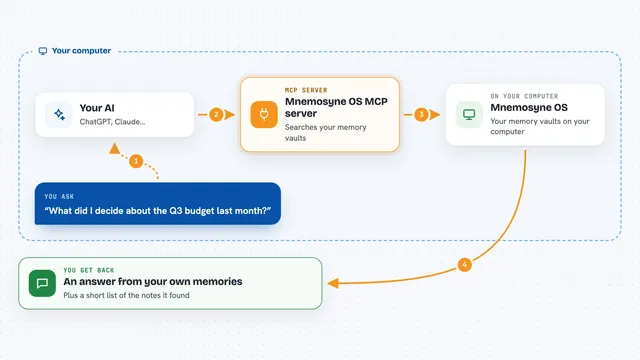
You talk to your AI as usual, and when something is worth keeping, the AI uses this helper to write it down. The helper saves that note in a local database file on your computer. Later, when you ask a question, the AI searches that memory and pulls back the most relevant pieces. Over time it also distills repeated facts into cleaner knowledge and lets stale details fade away. You get answers that remember your earlier conversations without you pasting old text back in.
 Click to zoom
What you can do with it
- Store a conversation message so your AI remembers it later
- Search your saved memories with a plain question
- Teach your AI a fact directly so it does not have to guess
- See memory statistics like how many episodes and facts are saved
- Get a list of preferences your AI has picked up about you
- Run a cleanup that removes duplicates and lets old items fade
- Delete memories by session, by age, or everything at once
- Import past conversations from Claude Code history files
What it gives back to you
You get answers in the chat that are based on your earlier conversations, not just the current message. When your AI searches memory, it can show a short list of matching notes with a relevance score next to each one. When it saves something, you get a small confirmation like a stored episode number. Status requests come back as a short summary of counts, such as how many episodes, facts, and preferences are saved.
Before you start
What you need
- An MCP-compatible AI app such as Claude Desktop, Claude Code, Cursor, or Cline
- Node.js installed if you use the npx install method (no Rust needed)
- Rust 1.75 or newer only if you build it from source
- Optional: an API key from an AI provider if you want automatic knowledge extraction
Good to know
This helper can delete memories, including everything at once, so be careful with the purge action and keep a backup of the memory file if it matters to you.
Install it with your AI
Add Alaya memory MCP server to your AI, no technical skills needed
You don't install anything by hand. You copy one prompt, paste it into an AI that can work on your computer, and it checks, installs and connects the server for you, asking you when it needs something.
Sign in to get the install prompt
Members get a ready-made prompt that lets the Claude desktop app check Alaya memory MCP server, install it and connect it for them, step by step. You don't need any technical skills: you copy, paste and answer a few questions. Your connected AI can also find and install any of the 4,066 MCP servers here for you.
Who it's for
People who use an AI assistant every day for work and want it to remember their projects, preferences, and past decisions without repeating themselves.